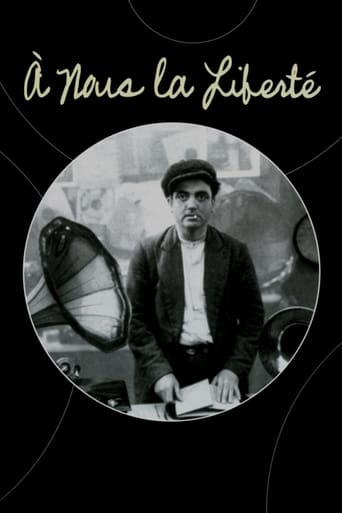
À Nous la Liberté (1931)
À nous la liberté
In this classic French satire, Louis, a convict, escapes from prison and takes on legitimate work, making his way up in the business world. Eventually becoming the head of a successful factory, Louis opts to modernize his company with mechanical innovations. But when his friend Émile finally leaves jail years later and reunites with Louis, the past catches up with them. The two, worried about being apprehended by police, long to flee the confines of industry.
- Date of release
- 1931-12-18
- TMDB
- 7.0 / 10 (123)
- Runtime
- 1h 35m
- Genres
- Comedy, Music
- Director
- René Clair
Casting
- Henri Marchand — Émile
- Raymond Cordy — Louis
- Rolla France — Jeanne
- Paul Ollivier — Paul Imaque, l'oncle
- Jacques Shelly — Paul
- Germaine Aussey — Maud
- Léon Lorin — Le vieux monsieur sourd
- Vincent Hyspa — Le vieil orateur
- André Michaud — Le contremaitre
- Maximilienne — Une invitée au diner
- Alexander D'Arcy — Le gigolo
- William Burke — L'ancien détenu
Interesting facts
- Awards: 0 · Nominations: 1
À nous la liberté, sometimes written as À nous la liberté!, is a 1931 French musical film directed by René Clair. With a score by Georges Auric, it has more music than any of Clair's other early works. Praised for its use of sound and Academy Award-nominated scenic design, the film has been called Clair's "crowning achievement".
Production
Along with his two first sound films, Sous les toits de Paris (1930) and Le Million (1931), À nous la liberté shows Clair continuing to experiment with the possibilities of sound film. At one point, the image of a flower, in combination with an unseen voice, leads the viewer to think the flower is singing. Once this is accepted, the viewer is able to accept that a chorus of flowers is singing when Émile views a window from his jail cell.
An aural flashback occurs when Émile re-encounters Louis, and a small argument results in Émile getting cut. As Louis bandages the cut, the soundtrack plays the non-musical marching of the prisoners (who wore wooden clogs).
Many sound effects are achieved, not through natural sound, but through Auric's musical score. In the phonograph factory, the "sound" of assembly line mechanization was depicted musically (using xylophones, among other instruments). There are several other passages, such as when Louis keys in the numbers to retrieve the profiles of Jeanne and her uncle, where the music supplies the only accompanying sound.
Read on Wikipedia · Text from Wikipedia, CC BY-SA 4.0. Data from Wikidata.
Recommended
- I'm All Right Jack 1959 · ★ 6.6
- Footlight Parade 1933 · ★ 6.8
- Taking Care of Business 1990 · ★ 6.3
- The Closet 2001 · ★ 6.5
- Accepted 2006 · ★ 6.5
- The Brats 2013 · ★ 6.1
- Podium 2004 · ★ 5.9
- Trophy Wife 2010 · ★ 6.1
- Head 1968 · ★ 6.2
- Robots 2005 · ★ 6.5
- Dead Weight 2002 · ★ 5.8
- The Girl Can't Help It 1956 · ★ 6.3