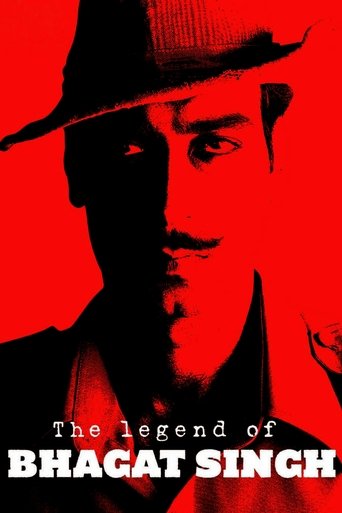
The Legend of Bhagat Singh (2002)
द लीज़ेंड ऑफ़ भगत सिंह
Born in British India, Bhagat Singh witnesses numerous atrocities during his childhood and grows up to become one of the most fearless freedom fighters in the country.
- Date of release
- 2002-06-07
- TMDB
- 7.2 / 10 (80)
- Runtime
- 2h 35m
- Genres
- Crime, Drama, History
- Director
- Rajkumar Santoshi
Casting
- Ajay Devgn — Bhagat K. Singh
- Amrita Rao — Mannewali
- Sushant Singh — Sukhdev
- Akhilendra Mishra — Chandrashekhar Azad
- D. Santosh — Rajguru
- Bhaswar Chatterjee — Batukeshwar Dutt
- Raj Babbar — Kishan Singh
- Farida Jalal — Vidyavati K. Singh
- Mukesh Tiwari — Jailor
- Sitaram Panchal — Lala Lajpat Rai
- Santosh Dhanoa — Shiviram Hari Rajguru
- Swaroop Kumar — Motilal Nehru
Interesting facts
- Awards: 2 · Nominations: 1. Including: National Film Award for Best Feature Film in Hindi; Filmfare Critics Award for Best Movie
The Legend of Bhagat Singh is a 2002 Indian biographical drama film directed by Rajkumar Santoshi. The film is based on Bhagat Singh, a revolutionary who fought for Indian independence along with fellow members of the Hindustan Socialist Republican Association. It features Ajay Devgn as the titular character along with Sushant Singh, Akhilendra Mishra and D. Santosh as the other lead characters. Raj Babbar, Farida Jalal and Amrita Rao play supporting roles. The film chronicles Singh's life from his childhood where he witnesses the Jallianwala Bagh massacre until the day he was hanged to death before the official trial dated 24 March 1931.
Production
In 1998, the film director Rajkumar Santoshi read several books on the socialist revolutionary, Bhagat Singh, and felt that a biopic would help revive interest in him. Although S. Ram Sharma made a film about Bhagat in 1965, titled Shaheed, Santoshi felt that despite being "a great source of inspiration on the lyrics and music front", it did not "dwell on Bhagat Singh's ideology and vision".
Santoshi gave Rajabali a copy of Shaheed Bhagat Singh, Kuldeep Khullar's biography of the revolutionary. Rajabali said that reading the book "created an intense curiosity in me about the mind of this man. I definitely wanted to know more about him." His interest in Bhagat intensified after he read The Martyr: Bhagat Singh's Experiments in Revolution (2000) by journalist Kuldip Nayar.
Rajabali wanted to "recreate the world that Bhagat Singh lived in", and his research required him to "not only understand the man, but also the influences on him, the politics of that era". In an interview with Sharmila Taliculam of Rediff.com in the year 2000, Rajabali said that the film would "deal with Bhagat Singh, the man, rather than the freedom fighter".
A. G. Noorani's 1996 book, The Trial of Bhagat Singh: Politics of Justice, provided the basis for the trial sequences. Gurpal obtained additional information from 750 newspaper clippings of The Tribune dated from September 1928 to March 1931, and from Bhagat's prison notebooks. These gave Rajabali "an idea of what had appealed to the man, the literary and intellectual influences that impacted him in that period".
Sunny Deol was initially cast as Bhagat Singh, but he left the project owing to schedule conflicts and differences with Santoshi. Santoshi then preferred to cast new faces instead of established actors but was not pleased with the performers who auditioned. Aamir Khan was also offered the role, but he declined, saying he wasn't young enough for the part.
Read on Wikipedia · Text from Wikipedia, CC BY-SA 4.0. Data from Wikidata.
Recommended
- Sam Bahadur 2023 · ★ 7.0
- Bharat 2019 · ★ 6.0
- A Call to Spy 2020 · ★ 6.8
- Viceroy's House 2017 · ★ 6.7
- A Passage to India 1984 · ★ 6.8
- Shirley 2024 · ★ 6.6
- Tanhaji: The Unsung Warrior 2020 · ★ 6.4
- The Last Rifleman 2023 · ★ 6.6
- Oranges and Sunshine 2010 · ★ 6.9
- Bonhoeffer: Pastor. Spy. Assassin 2024 · ★ 6.8
- Richard Jewell 2019 · ★ 7.4
- The Way Back 2010 · ★ 7.0