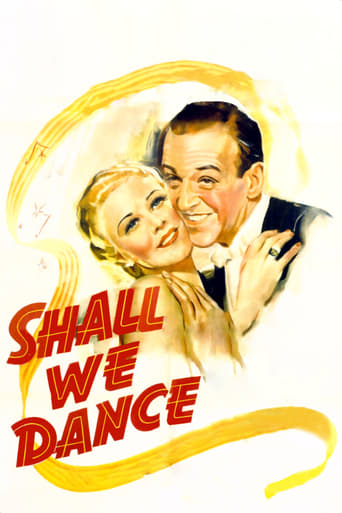
Shall We Dance (1937)
Foot-free Fred and joyous Ginger...in their gayest, gladdest show!
Ballet star Petrov arranges to cross the Atlantic aboard the same ship as the dancer and musical star he's fallen for but barely knows. By the time the ocean liner reaches New York, a little white lie has churned through the rumour mill and turned into a hot gossip item—that the two celebrities are secretly married.
- Date of release
- 1937-05-07
- TMDB
- 7.3 / 10 (126)
- Runtime
- 1h 49m
- Genres
- Comedy, Romance
- Director
- Mark Sandrich
Casting
- Fred Astaire — Petrov
- Ginger Rogers — Linda Keene
- Edward Everett Horton — Jeffrey Baird
- Eric Blore — Cecil Flintridge
- Jerome Cowan — Arthur Miller
- Ketti Gallian — Lady Tarrington
- William Brisbane — Jim Montgomery
- Ann Shoemaker — Matron
- Harriet Hoctor — Ballet Dancer
- Rolfe Sedan — Ballet Master (uncredited)
- Richard Tucker — Mr. Russell (uncredited)
- Ben Alexander — Evans (uncredited)
Interesting facts
Shall We Dance is a 1937 American musical comedy film directed by Mark Sandrich. It is the seventh of the ten Fred Astaire-Ginger Rogers films. The story follows a Russian-imposter ballet dancer (Astaire) who falls in love with a tap dancer (Rogers); the tabloid press concocts a story of their marriage, after which life imitates art. George Gershwin wrote the symphonic underscore and Ira Gershwin the lyrics, for their second Hollywood musical. It inspired the 1996 Japanese-language remake of the same name.
Production
The idea for the film originated in the studio's desire to exploit the successful formula created by Richard Rodgers and Lorenz Hart with their 1936 Broadway hit On Your Toes. In a major coup for RKO, Pandro Berman managed to attract the Gershwins – George Gershwin, who wrote the symphonic underscore, and Ira Gershwin, the lyrics – to score this, their second Hollywood musical after Delicious in 1931.
The film – Astaire and Rogers's most expensive to date – features well-known comedic actors in support, art direction by Carroll Clark under Van Nest Polglase's supervision, and a score which introduces three Gershwin songs that went on to become classics.
Astaire was no stranger to the Gershwins, having headlined, with his sister Adele, two Gershwin Broadway shows: Lady Be Good! in 1924 and Funny Face in 1927. George Gershwin also accompanied the pair on piano in a set of recordings in 1926. Rogers first came to Hollywood's attention when she appeared in the Gershwins' 1930 stage musical Girl Crazy.
Shall We Dance was named at the suggestion of Vincente Minnelli, who was a friend of the Gershwins. Minnelli originally suggested "Shall We Dance?" with a question mark, which disappeared at some point.
The car used on the ferry was 1936 Packard Twelve Coupe Roadster.
Read on Wikipedia · Text from Wikipedia, CC BY-SA 4.0. Data from Wikidata.
Recommended
- Swing Time 1936 · ★ 6.8
- Dancing Lady 1933 · ★ 6.9
- The Band Wagon 1953 · ★ 7.2
- You'll Never Get Rich 1941 · ★ 6.5
- You Were Never Lovelier 1942 · ★ 7.1
- The Tender Trap 1955 · ★ 6.2
- A Good Woman 2004 · ★ 6.3
- Let's Make Love 1960 · ★ 6.4
- Les Girls 1957 · ★ 6.4
- The Gay Divorcee 1934 · ★ 6.9
- Top Hat 1935 · ★ 7.2
- Silk Stockings 1957 · ★ 6.8