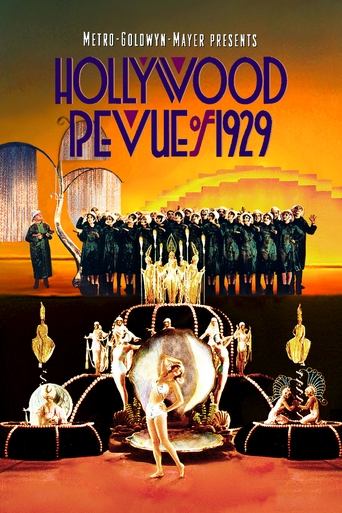
The Hollywood Revue of 1929 (1929)
25 of the screen's greatest stars - chorus of 200 - amazingly revolutionary motion picture!
An all-star revue featuring MGM contract players.
- Date of release
- 1929-11-23
- TMDB
- 5.7 / 10 (38)
- Runtime
- 1h 58m
- Genres
- Comedy, Music
- Director
- Charles Reisner
Casting
- Conrad Nagel — Self - Master of Ceremonies
- Jack Benny — Self - Master of Ceremonies
- John Gilbert — Self / Romeo
- Norma Shearer — Self / Juliet
- Joan Crawford — Self
- Bessie Love — Self
- Cliff Edwards — Self
- Stan Laurel — Self
- Oliver Hardy — Self
- Anita Page — Self
- Lorayne Brox — Self - One of the Brox Sisters
- Bobbe Brox — Self - One of the Brox Sisters
Interesting facts
- Awards: 0 · Nominations: 1
The Hollywood Revue of 1929, or simply The Hollywood Revue, is a 1929 American pre-Code musical comedy film released by Metro-Goldwyn-Mayer. It was the studio's second feature-length musical, and one of their earliest sound films. Produced by Harry Rapf and directed by Charles Reisner, it features nearly all of MGM's stars in a two-hour revue that includes three segments in Technicolor. The masters of ceremonies are Conrad Nagel and Jack Benny.
Production
The film went into production as The Revue of Revues, and the title was changed in May 1929. John Gilbert, Norma Shearer, Lionel Barrymore, and Marion Davies were added to the cast in June.
Unlike MGM's imposing feature films, which always boasted strong story values, The Hollywood Revue of 1929 is a plotless parade of variety acts. This was a daring gamble for the studio, uncertain if the public would accept an MGM picture with no storyline at all.
Highlights of The Hollywood Revue are a comedy routine starring Stan Laurel and Oliver Hardy as inept magicians; Buster Keaton in a "Queen of Sheba" pantomime dance; John Gilbert and Norma Shearer enacting the balcony scene from Romeo and Juliet, first with the original Shakespearean dialogue, then with contemporary slang (this sequence was written by the studio's veteran gagman Joe Farnham); Bessie Love demonstrating her musical-comedy talents;…
Only one sequence was cut from the film: three songs by The Brox Sisters, which was recycled into a short subject, Gems of MGM. Another sequence, a parody of the Albertina Rasch ballet's "pearl dance" by Marie Dressler, was planned but not shot (as the film's production records reveal). Instead, the number was replaced by the Buster Keaton specialty, though Dressler did pose for stills wearing a Lady Godiva wig.
The film is sometimes cited, as on the DVD release of the 1952 Singin' in the Rain, as the film that led to the downfall of Gilbert's career. Gilbert, a popular silent film actor best known for his work opposite Garbo, possessed a pleasant, tenor speaking voice which did not always match his heroic, dashing screen image.
Read on Wikipedia · Text from Wikipedia, CC BY-SA 4.0. Data from Wikidata.
Recommended
- Ziegfeld Follies 1945 · ★ 6.0
- Bo Burnham: Make Happy 2016 · ★ 8.0
- John Mulaney & The Sack Lunch Bunch 2019 · ★ 7.0
- King of Jazz 1930 · ★ 6.5
- A Song Is Born 1948 · ★ 6.5
- Babes in Arms 1939 · ★ 6.4
- Bo Burnham: What. 2013 · ★ 7.8
- The After Party 2018 · ★ 6.1
- The Big Store 1941 · ★ 6.3
- Footlight Parade 1933 · ★ 6.9
- Popstar: Never Stop Never Stopping 2016 · ★ 6.6
- Jeff Dunham: Controlled Chaos 2011 · ★ 6.7