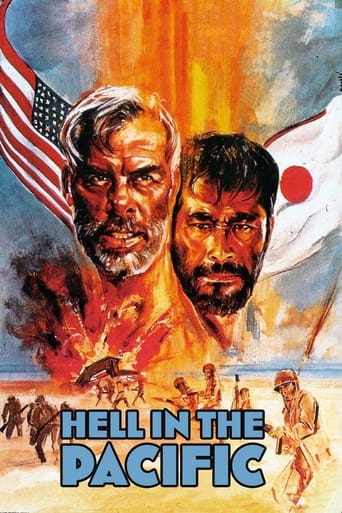
Hell in the Pacific (1968)
Out of violence, compassion. Out of suspicion, trust. Out of hell, hope.
During World War II, a shot-down American pilot and a marooned Japanese navy captain find themselves stranded on the same small uninhabited island in the Pacific Ocean.
- Date of release
- 1968-12-19
- TMDB
- 7.0 / 10 (199)
- Runtime
- 1h 43m
- Genres
- Drama, War, Adventure
- Director
- John Boorman
Casting
- Lee Marvin — American Pilot
- Toshirō Mifune — Captain Tsuruhiko Kuroda
Interesting facts
- Box office: $3.2M
- Budget: $4.2M
- Earned 0.8× its budget
Hell in the Pacific is a 1968 wartime survival film directed by John Boorman and starring Lee Marvin and Toshiro Mifune, the only two actors in the film. Set in the Pacific War, it follows an American pilot and a Japanese naval officer who are stranded on the same uninhabited island. It is about the importance of human contact and the bond that can form between enemies if they lack external influences.
Production and release
The film contains little dialogue, and much like the thematically-similar None but the Brave (1965), the dialogue is not dubbed or subtitled, authentically portraying the frustration of restricted communication between the Japanese- and English-speaker. The film was entirely shot in the Rock Islands of Palau in the north Pacific Ocean, near the Philippines in the Philippine Sea.
The film was originally released with the actors solemnly walking away from one another. When it opened in Britain, the producers changed it with an abrupt ending in which a random shell strikes their building, killing them both. Boorman was surprised by the change, which he was not informed of, and said he "hated it", viewing it as too cynical for them to have gone through everything just to be killed at the end.
Both actors served for their respective countries during World War II. Marvin, who was in the United States Marine Corps, was wounded and received the Purple Heart during the Battle of Saipan in 1944. Mifune served in the Imperial Japanese Army Air Service.
The film earned rentals of $1.33 million in North America and $1.9 million elsewhere. Because of the high costs involved, by 1973 the movie had recorded a loss of $4,115,000, making it one of the biggest money losers in the short history of ABC films.
Read on Wikipedia · Text from Wikipedia, CC BY-SA 4.0. Data from Wikidata.
Recommended
- Tora! Tora! Tora! 1970 · ★ 7.2
- Flags of Our Fathers 2006 · ★ 6.9
- Flyboys 2006 · ★ 6.5
- Letters from Iwo Jima 2006 · ★ 7.5
- The Thin Red Line 1998 · ★ 7.4
- Twelve O'Clock High 1949 · ★ 7.2
- Too Late the Hero 1970 · ★ 6.4
- Unbroken 2014 · ★ 7.4
- Behind Enemy Lines 2001 · ★ 6.5
- Hacksaw Ridge 2016 · ★ 8.2
- The Caine Mutiny Court-Martial 2023 · ★ 6.7
- Farewell to the King 1989 · ★ 6.0