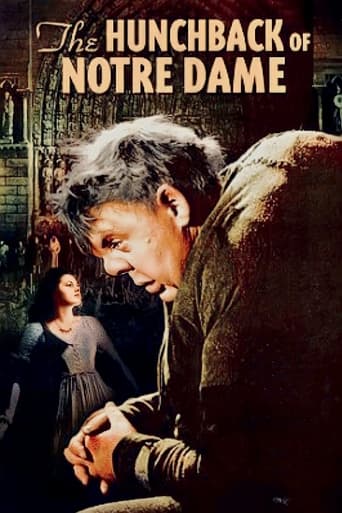
The Hunchback of Notre Dame (1939)
Impact! Power! Fire! Pathos! Drama!
Paris, France, 1482. Frollo, Chief Justice of benevolent King Louis XI, gets infatuated by the beauty of Esmeralda, a young Romani girl. The hunchback Quasimodo, Frollo's protege and bell-ringer of Notre Dame, lives in peace among the bells in the heights of the immense cathedral until he is involved by the twisted magistrate in his malicious plans to free himself from Esmeralda's alleged spell, which he believes to be the devil's work.
- Date of release
- 1939-08-31
- TMDB
- 7.3 / 10 (234)
- Runtime
- 1h 57m
- Genres
- Drama, Romance, Horror
- Director
- William Dieterle
Casting
- Charles Laughton — The Hunchback Quasimodo
- Cedric Hardwicke — Frollo
- Thomas Mitchell — Clopin
- Maureen O'Hara — Esmeralda
- Edmond O'Brien — Gringoire
- Alan Marshal — Phoebus
- Walter Hampden — Archdeacon
- Harry Davenport — King Louis XI
- Katharine Alexander — Madame de Lys
- George Zucco — Procurator
- Fritz Leiber — Old Nobleman
- Etienne Girardot — Doctor
Interesting facts
- Budget: $1.8M
- Based on: The Hunchback of Notre Dame
- Awards: 0 · Nominations: 2
The Hunchback of Notre Dame is a 1939 American romantic drama film starring Charles Laughton and Maureen O'Hara. Directed by William Dieterle and produced by Pandro S. Berman, the film is based on Victor Hugo's 1831 novel. It is also noted for being the only film shown at the newly established Cannes Film Festival; the rest of the festival was cancelled due to the start of World War II.
Production
In 1932, it was reported by The Hollywood Reporter that Universal announced that it would remake the 1923 Hunchback of Notre Dame film with John Huston writing a script and that Boris Karloff would play Quasimodo.
Irving Thalberg, who was an uncredited producer in the 1923 film, considered remaking the film in 1934 and even discussed the idea with Charles Laughton. Two years later, Universal regained interest in a remake, with a fan poll being instrumental in influencing the studio to make the film.
A year later, Carl Laemmle Jr. persuaded Metro-Goldwyn-Mayer to buy the property from Universal as a star-vehicle for Muni. Metro refused and sold the rights to RKO, with Pandro S. Berman producing and William Dieterle directing.
For this production, RKO Radio Pictures built on their movie ranch a massive medieval city of Paris and Notre Dame Cathedral in the San Fernando Valley. This was one of the largest and most extravagant sets ever constructed.
Screenwriter Sonya Levien, who was entrusted to translate Hugo's novel into this film, made the story relevant to the events of the time the film was made: she made the obvious parallel between Paris' persecution of the Romani and Germany's treatment of the Jews prior to World War II.
Read on Wikipedia · Text from Wikipedia, CC BY-SA 4.0. Data from Wikidata.
Recommended
- Les Misérables 1998 · ★ 7.2
- Winter's Tale 2014 · ★ 6.3
- I Capture the Castle 2003 · ★ 6.7
- Jane Eyre 1996 · ★ 6.9
- Cyrano de Bergerac 1950 · ★ 6.9
- Charlie St. Cloud 2010 · ★ 7.0
- The Man in the Moon 1991 · ★ 7.4
- Wuthering Heights 1992 · ★ 6.7
- Head in the Clouds 2004 · ★ 5.9
- Before Sunset 2004 · ★ 7.8
- Tess 1979 · ★ 7.1
- Moll Flanders 1996 · ★ 6.1