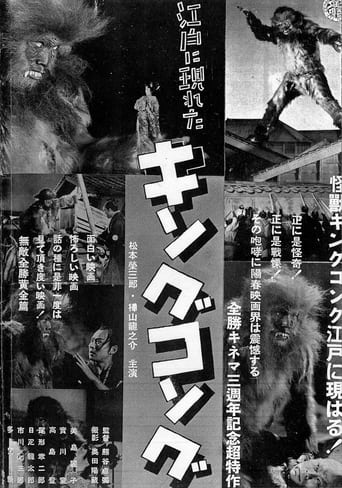
The King Kong That Appeared in Edo (1938)
江戸に現れたキングコング
A lost film considered one of Japan's first Tokusatsu films. The effects were done by Fuminori Ohashi, who claims to have been a modeling consultant for Godzilla 1954 (this claim is disputed by modeler Eizo Kaimai and art staff member Shinji Hiruma). The film's synopsis published in the March 1938 issue of Kinema Junpo indicates that the "Kong" featured in this film was not actually a giant monster.
- Date of release
- 1938-03-18
- TMDB
- 6.7 / 10 (3)
- Runtime
- 50m
- Genres
- Adventure, Action, Horror
- Director
- Sôya Kumagai
Casting
- Eizaburo Matsumoto — Misato Magonojo
- Fuminori Ōhashi — Anthropoid
- Reizaburo Ichikawa — Toba Hyoei
- Reiko Mishima — Chinami
- Shojiro Ogata — Kuroami the Hunchback
- Yasutaro Yagi — Inoue Ginbei
- Noboru Takashima — Kawasaki Yuzuru
- Keinosuke Yashiro — Segawa Kinnosuke
- Shotaro Shiba — Azuma Tetsusaburo
- Shin Taga — Nakazawa Shinjûro
- Ryutaro Hibiki — Matsudaira Izunokami
- Keisuke Matsudaira — Clerk at charcoal shop
Interesting facts
- Filmed in: Japan
The King Kong That Appeared in Edo , often translated as King Kong Appears in Edo, is a 1938 Japanese two-part silent jidaigeki film directed by Sōya Kumagai and produced by Zenshō Cinema. It is now considered to be a lost film.
Production
This silent period piece drama film was produced in 1938 by Zenshō Cinema, which had never obtained rights permission from RKO Pictures, the company that owned the name "King Kong" at that time. The film was broken into two parts.
Going by the plot synopsis as well as flyers promoting the film, it is believed by historians that the ape (looking more like a yeti) is referred to as "King Kong" in name only and does not appear gigantic outside of promotional photos. These photos that appear on the film's flyers and advertisements depict him being so big that he is holding Chinami in the palm of his hand and is straddling buildings as he faces down Hyoue Toba's men.
However, suit creator and actor Ryūnosuke Kabayama (who later changed his name to Fuminori Ohashi and created the ape creatures seen in the 1956 films 水戸黄門 怪力類人猿 [Mito Kōmon: Kairiki Ruijinen] and 水戸黄門漫遊記 人喰い狒々 [Mito Kōmon Manyūki: Hitokui Hihi], as well as the suit for Godzilla in the original 1954 film) and various other tokusatsu productions stated in a 1988 interview: "The first model making to be counted as 'special art direction' in Japanes…
Read on Wikipedia · Text from Wikipedia, CC BY-SA 4.0. Data from Wikidata.
Recommended
- Primeval 2007 · ★ 6.2
- Naruto the Movie: Guardians of the Crescent Moon Kingdom 2006 · ★ 7.1
- Jungle Run 2021 · ★ 5.9
- K-20: The Fiend with Twenty Faces 2008 · ★ 6.1
- Naruto Shippuden the Movie: The Lost Tower 2010 · ★ 7.2
- Jurassic World Camp Cretaceous: Hidden Adventure 2022 · ★ 6.7
- Street Fighter: Assassin's Fist The Movie 2014 · ★ 7.2
- They Reach 2020 · ★ 6.8
- Godzilla vs. Megalon 1973 · ★ 6.2
- American Ninja 1985 · ★ 6.0
- Tales of the Black Freighter 2009 · ★ 6.6
- Castle in the Sky 1986 · ★ 8.0