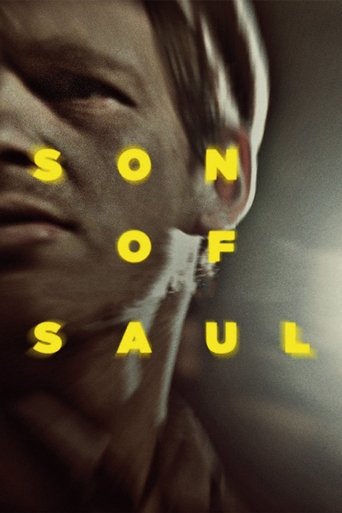
Son of Saul (2015)
Saul fia
In the horror of 1944 Auschwitz, a prisoner forced to burn the corpses of his own people finds moral survival trying to save from the flames the body of a boy he takes for his son, seeking to give him a proper Jewish burial.
- Date of release
- 2015-06-11
- TMDB
- 7.1 / 10 (1210)
- Runtime
- 1h 47m
- Genres
- War, Drama, Thriller
- Director
- László Nemes
Casting
- Géza Röhrig — Saul Ausländer
- Levente Molnár — Abraham
- Urs Rechn — Eli Biederman
- Todd Charmont — Bearded Prisoner
- Jerzy Walczak — Rabbi Frankel
- Balázs Farkas — Saul's Son
- Gergö Farkas — Saul's Son
- Sándor Zsótér — Dr. Miklós Nyiszli
- Marcin Czarnik — Feigenbaum
- Levente Orbán — Russian Prisoner
- Kamil Dobrowolski — Mietek
- Uwe Lauer — Oberscharführer Voss
Interesting facts
- Filmed in: Budapest
- Awards: 12 · Nominations: 2. Including: Cannes Film Festival Grand Prix; François Chalais Prize; CST Award of the Technical Artist; National Board of Review Award for Best Foreign Language Film
Son of Saul is a 2015 Hungarian historical drama film directed by László Nemes, in his feature directorial debut, and co-written by Nemes and Clara Royer. It is set in the Auschwitz concentration camp during World War II, and follows a day-and-a-half in the life of Saul Ausländer, a Hungarian member of the Sonderkommando.
Production
Nemes conceived of the film from the book The Scrolls of Auschwitz, a collection of testimonies by Sonderkommando members, after discovering it during the production of Béla Tarr's The Man from London in 2005 when he was working as Tarr's assistant. Nemes started working on the screenplay with Royer in 2010 and completed the first draft in 2011.
The project struggled to find financial backers due to the film's unconventional approach and Nemes's lack of experience in directing a feature film. Originally intended to be a French production with a French protagonist, the film was produced entirely in Hungary.
Nemes insisted on casting actors who spoke their characters' own languages. New York City-based Hungarian poet Géza Röhrig, who had not acted in film since the 1980s, was cast as the main character, Saul, after being considered originally for a supporting role.
The film was shot on 35 mm film in 28 days in Budafok, Budapest. A 40 mm lens and the Academy aspect ratio of 1.375:1 were adopted to realise shallow focus and a portrait-like narrow field of vision. Architect and liberal activist László Rajk, who also worked on the permanent Hungarian exhibition at the Auschwitz-Birkenau State Museum, designed the re-creation of the crematoria.
The film took five months of sound design. Human voices in eight languages were recorded and attached to the original recording of the production. Sound designer Tamás Zányi described the sound in the film "as a sort of acoustic counterpoint to the intentionally narrowed imagery". The film is composed of 85 shots.
Read on Wikipedia · Text from Wikipedia, CC BY-SA 4.0. Data from Wikidata.
Recommended
- The Grey Zone 2001 · ★ 6.6
- Adam Resurrected 2008 · ★ 6.1
- Escape from Sobibor 1987 · ★ 7.2
- Fateless 2005 · ★ 6.9
- Conspiracy 2001 · ★ 7.3
- Inglourious Basterds 2009 · ★ 8.2
- The World Will Tremble 2025 · ★ 7.5
- Irena's Vow 2024 · ★ 7.7
- Schindler's List 1993 · ★ 8.6
- Truth & Treason 2025 · ★ 8.1
- Operation Finale 2018 · ★ 6.7
- The Courageous Heart of Irena Sendler 2009 · ★ 7.4