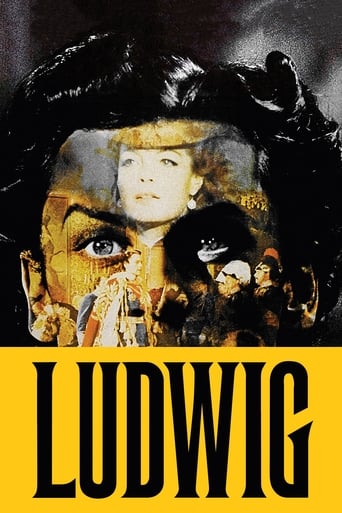
Ludwig (1973)
Ludwig. He loved women. He loved men. He lived as controversially as he ruled. But he did not care what the world thought. He was the world.
Historical evocation of Ludwig, king of Bavaria, from his crowning in 1864 until his death in 1886, as a romantic hero. Fan of Richard Wagner, betrayed by him, in love with his cousin Elisabeth of Austria, abandoned by her, tormented by his homosexuality, he will little by little slip towards madness.
- Date of release
- 1973-03-07
- TMDB
- 7.5 / 10 (198)
- Runtime
- 3h 59m
- Genres
- Drama, History
- Director
- Luchino Visconti
Casting
- Helmut Berger — Ludwig
- Romy Schneider — Elisabeth of Austria
- Trevor Howard — Richard Wagner
- Silvana Mangano — Cosima von Bülow
- Gert Fröbe — Father Hoffmann
- Helmut Griem — Dürckheim
- Izabella Telezynska — Queen Mother
- Umberto Orsini — Count von Holnstein
- John Moulder-Brown — Prince Otto
- Sonia Petrovna — Sophie
- Folker Bohnet — Joseph Kainz
- Heinz Moog — Professor von Gudden
Interesting facts
- Filmed in: Munich and Bavaria
- Awards: 1 · Nominations: 1. Including: David di Donatello for Best Film
Ludwig is a 1973 epic biographical drama film co-written and directed by Luchino Visconti. The film stars Helmut Berger as King Ludwig II of Bavaria and Romy Schneider as Empress Elisabeth of Austria, along with Trevor Howard, Silvana Mangano, Helmut Griem, and Gert Fröbe. It is the third and final part of Visconti's "German Trilogy", following The Damned (1969) and Death in Venice (1971).
Production
Ludwig was filmed at Cinecitta Studios in Rome, and on-location in Bavaria, West Germany. Filming took place at Roseninsel, Berg Castle, Lake Starnberg, Castle Herrenchiemsee, Castle Hohenschwangau, Linderhof Palace, Cuvilliés Theatre, Nymphenburg Palace, Ettal, Kaiservilla and Neuschwanstein Castle. Shooting began in late January 1972 and lasted six months.
Luchino Visconti, who was a distant relative of Ludwig II through Margarete von Bayern and Federico I Gonzaga, was fascinated by the story of the loner and esthete monarch and saw him as "the last absolutist ruler who preferred to rule with art rather than politics".
Much like The Damned and Death in Venice, Visconti shot Ludwig in English to account for the different nationalities in the cast (a mix of German, English, and Italian speakers). Scenes were shot silent (MOS) and then the actors looped their lines in post-production. While most of the German-speaking cast dubbed their own lines for the German release, Helmut Berger was replaced by a different actor due to his Austrian accent.
During the last stages of production, on July 27, 1972, Visconti suffered a stroke. In the documentary The Life and Times of Count Luchino Visconti, screenwriter Enrico Medioli claimed the illness was caused by the sudden transition from the cold of the Austrian countryside to the heat of the Cinecittà soundstages.
Read on Wikipedia · Text from Wikipedia, CC BY-SA 4.0. Data from Wikidata.
Recommended
- Victoria & Abdul 2017 · ★ 6.9
- Amadeus 1984 · ★ 8.0
- The Happy Prince 2018 · ★ 6.2
- Julia 1977 · ★ 6.5
- Colette 2018 · ★ 6.9
- The Lion in Winter 1968 · ★ 7.4
- Munich - The Edge of War 2021 · ★ 6.9
- Priscilla 2023 · ★ 6.7
- Milk 2008 · ★ 7.2
- Hamlet 1990 · ★ 6.6
- The Count of Monte Cristo 2002 · ★ 7.7
- Snow Flower and the Secret Fan 2011 · ★ 6.1