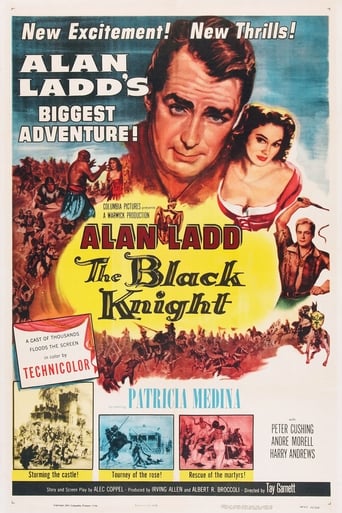
The Black Knight (1954)
Alan Ladd's greatest ! Bigger than ever ! Better than ever ! Bolder than ever !
John, a blacksmith and swordsmith, is tutored at Camelot. As a commoner, he can't hope to win the hand of Lady Linet, daughter of the Earl of Yeoniland, so he creates a secret alternate identity as the Black Knight. In this new role, he is now able to help King Arthur when Saracens and Cornish men—disguised as Vikings -- plot to take over the country.
- Date of release
- 1954-08-26
- TMDB
- 6.4 / 10 (11)
- Runtime
- 1h 25m
- Genres
- Action, Adventure
- Director
- Tay Garnett
Casting
- Alan Ladd — John
- Patricia Medina — Linet
- André Morell — Sir Ontzlake
- Harry Andrews — Earl Of Yeonil
- Peter Cushing — Sir Palamides
- Anthony Bushell — King Arthur
- Laurence Naismith — Major Domo
- Patrick Troughton — King Mark
- Bill Brandon — Bernard
- Ronald Adam — The Abbot
- Basil Appleby — Sir Hal
- Tommy Moore — The Apprentice
Interesting facts
- Box office: $1.3M
- Budget: $1M
- Earned 1.3× its budget
- Filmed in: Pinewood Studios
The Black Knight is a 1954 British-American Technicolor medieval adventure film directed by Tay Garnett and starring Alan Ladd as the title character and Peter Cushing and Patrick Troughton as two conspirators attempting to overthrow King Arthur. It is the last of Ladd's trilogy with Warwick Films, the others being The Red Beret and Hell Below Zero based on Hammond Innes' book The White South.
Production
The Black Knight was the fourth film Alan Ladd made outside the US in order to qualify for a tax exemption. His fee was $200,000 as against 10% of the gross.
Filming started in September 1953. Shooting took place at Pinewood Studios, with exterior shots filmed at Castell Coch, Wales, and on location in Ávila, Spain. Producer Irving Allen called Spain "a wonderful country to make pictures in" because of its more than 2,000 old castles, twelve of which were used in the film. The film's sets were designed by the art director Alex Vetchinsky.
Halfway through production, Bryan Forbes was called in to do some rewriting of the script (he is credited as "additional dialogue by..."). According to Forbes's memoirs, Alan Ladd's wife and long-time agent, Sue Carol, had script approval and objected to a scene where her husband's character stole a horse. 'During a script conference she repeated "Alan Ladd does not steal a horse, period. I'm telling you.
Donald Sinden, then a contract star for the Rank Organisation at Pinewood Studios, had a permanent dressing room in the same block as Ladd's. He said "(Ladd) brought in his entourage a double-come-stunt man who bore an uncanny resemblance to him. The double did all the long shots, most of the medium shots and even appeared in two-shots when the hero had his back to the camera. The 'star' only did eleven days work in the entire film.
The title tune for the film was "The Whistling Gypsy". For this purpose it was given new lyrics by its songwriter, Leo Maguire, and Elton Hayes, who sang it in the film.
Read on Wikipedia · Text from Wikipedia, CC BY-SA 4.0. Data from Wikidata.
Recommended
- The Green Knight 2021 · ★ 6.6
- Ironclad 2011 · ★ 6.2
- Excalibur 1981 · ★ 7.0
- Pilgrimage 2017 · ★ 6.0
- Primeval 2007 · ★ 6.2
- Medieval 2022 · ★ 6.8
- Ivanhoe 1982 · ★ 6.4
- A Knight's War 2025 · ★ 6.2
- Conan the Barbarian 1982 · ★ 6.8
- The Losers 2010 · ★ 6.3
- Kingdom of Heaven 2005 · ★ 7.1
- Robin Hood 2018 · ★ 5.9