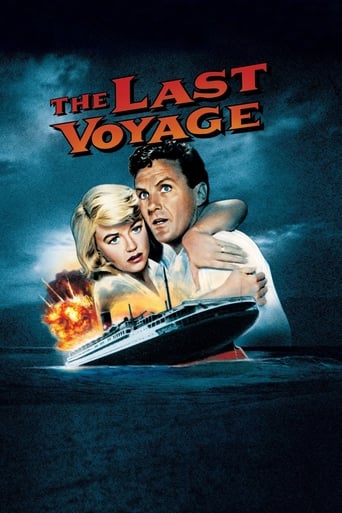
The Last Voyage (1960)
FIND YOUR S.Q.! What is your Suspense Quotient? How Much Suspense Can You Take?
The S. S. Claridon is scheduled for her five last voyages after thirty-eight years of service. After an explosion in the boiler room, Captain Robert Adams is reluctant to evacuate the steamship. While the crew fights to hold a bulkhead between the flooded boiler room and the engine room and avoid the sinking of the vessel, the passenger Cliff Henderson struggles against time trying to save his beloved wife Laurie Henderson, who is trapped under a steel beam in her cabin, with the support of the crew member Hank Lawson.
- Date of release
- 1960-02-19
- TMDB
- 6.2 / 10 (48)
- Runtime
- 1h 31m
- Genres
- Thriller, Drama, Action
- Director
- Andrew L. Stone
Casting
- Robert Stack — Cliff Henderson
- Dorothy Malone — Laurie Henderson
- George Sanders — Capitaine Robert Adams
- Edmond O'Brien — Second Engineer Walsh
- Woody Strode — Hank Lawson
- Jack Kruschen — Chief Engineer Pringle
- Joel Marston — Third Officer Ragland
- George Furness — Third Officer Osborne
- Marshall Kent — Quartermaster
- Andrew Hughes — Radio Operator
- Tammy Marihugh — Jill Henderson
- Richard Norris — 3rd Engineer Cole
Interesting facts
- Box office: $2.1M
- Budget: $1.4M
- Earned 1.5× its budget
- Awards: 0 · Nominations: 1
The Last Voyage is a 1960 Metrocolor American disaster film starring Robert Stack, Dorothy Malone, George Sanders, and Edmond O'Brien. It was written and directed by Andrew L. Stone. It was the first MGM film of the 1960s.
Production
Stuart Whitman was originally announced for the male lead, and Sidney Poitier for the role of Hank Lawson.
The film originally was scheduled to be shot in CinemaScope off the coast of England, but instead it was filmed almost entirely in the Inland Sea off the coast of Osaka causing noticeable consistency conflicts in the film. For example, in the beginning of the film all of the shipboard extras are of European origin however as the ship begins to sink,(and the outdoor filming moves to Inland Sea) a majority of the shipboard guests (extras) become As…
The ship used in the film was the French luxury liner SS Ile de France, which had been in service from 1927 until 1959, when it was sold to a Japanese scrapyard. Its former owners initially attempted to block Stone's rental of it (for $1.5 million), but withdrew their opposition when MGM agreed not to identify it by its original name when publicizing the film.
A LIFE magazine essay about the ship's scrapyard fate—and the film's production—included many photographs and production details. For the climactic explosion scene, "the likeliest place seemed to be the bay of Sumoto, a port on the island of island of Awaji 20 miles away....But the insurance captain declared that it would be necessary to strengthen the bulkheads and install new steam lines before the liner could be allowed to make the trip....The…
In his autobiography Straight Shooting, Robert Stack recalled, "No special effects for Andy [Stone]; he actually planned to destroy a liner and photograph the process. Thus began a film called The Last Voyage, which...for yours truly very nearly lived up to its title." According to William H.
Read on Wikipedia · Text from Wikipedia, CC BY-SA 4.0. Data from Wikidata.
Recommended
- Islands 2025 · ★ 6.1
- Nancy 2018 · ★ 5.8
- Sleep, My Love 1948 · ★ 6.3
- Time Without Pity 1957 · ★ 6.5
- The Quiller Memorandum 1966 · ★ 5.9
- Airport 1970 · ★ 6.5
- The Locket 1946 · ★ 6.3
- Indemnity 2022 · ★ 6.6
- The Poseidon Adventure 1972 · ★ 7.2
- Point Blank 1967 · ★ 7.1
- Foreign Correspondent 1940 · ★ 7.0
- Doctor Who: Voyage of the Damned 2007 · ★ 7.6