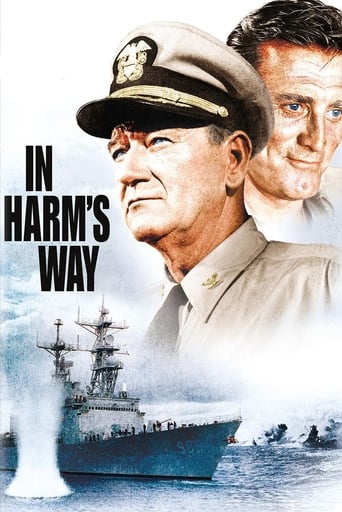
In Harm's Way (1965)
Stripped of everything - they lived and loved and fought as if there were no tomorrow...
A Naval officer, reprimanded after Pearl Harbor, is later promoted to Rear Admiral and gets a second chance to prove himself against the Japanese.
- Date of release
- 1965-04-06
- TMDB
- 6.6 / 10 (171)
- Runtime
- 2h 45m
- Genres
- War, Drama
- Director
- Otto Preminger
Casting
- John Wayne — Capt. Rockwell Torrey
- Kirk Douglas — Commander Paul Eddington, Jr.
- Patricia Neal — Lt. Maggie Hayes
- Tom Tryon — Mac McConnell
- Paula Prentiss — Beverly McConnell
- Brandon De Wilde — Ens. Jeremiah 'Jere' Torrey
- Jill Haworth — Ens. Annalee Dorne
- Dana Andrews — Admiral Broderick
- Stanley Holloway — Clayton Canfil
- Burgess Meredith — Commander Egan Powell
- Barbara Bouchet — Liz Eddington
- Franchot Tone — CINCPAC I
Interesting facts
- Based on: Harm's Way
- Filmed in: San Diego, Ford Island, Marine Corps Air Station Kaneohe Bay, Honolulu, San Francisco, USS Braine and 6 more
- Awards: 0 · Nominations: 1
In Harm's Way is a 1965 American epic historical romantic war film produced and directed by Otto Preminger and starring John Wayne, Kirk Douglas, and Patricia Neal. The supporting cast featured Henry Fonda in a lengthy cameo, Tom Tryon, Paula Prentiss, Stanley Holloway, Burgess Meredith, Brandon deWilde, Jill Haworth, Dana Andrews, and Franchot Tone. Produced with Panavision motion picture equipment, it was one of the last black-and-white World War II epics, and Wayne's last black-and-white film. The screenplay was written by Wendell Mayes, based on the 1962 novel Harm's Way, by James Bassett.
Background and production
Wendell Mayes, who wrote the script, had worked on the project when Preminger was in Europe, and then paused on it when the film was called off. He commenced writing it again two years later which he felt helped the script because by that stage he had forgotten the novel and could approach it more freshly.
Mayes wanted John Wayne to die at the end while the son lived but Otto Preminger felt audiences would not accept John Wayne dying. "I didn't much care for the Kirk Douglas character," said Mayes. "I thought he was sort of dragged in. He had a few things that were rather good, but actually that gung ho, derring-do, flying the plane after raping the girl, somehow doesn't seem part of the story to me; it seems like something else.
John Wayne's low-key performance was thought to be because he was seriously ill with lung cancer when the film was made. Shortly after filming ended in September 1964, he was diagnosed with the disease and a month later underwent surgery to remove his entire left lung and two ribs. Co-star Franchot Tone was soon to also develop lung cancer, and died of the disease in September 1968.
This was Patricia Neal's last film before suffering three life threatening cerebral aneurysms while pregnant which took her two years to recover from. Neal did not make another film until she was cast as the mother in The Subject Was Roses in 1968.
Many of the non-military costumes and hairstyles worn by the women throughout the film were contemporary to the mid-1960s period during which the film was made, rather than of the early 1940s. This is particularly noticeable at the dance that opens the film. Many of the extras in this scene were, in fact, current active-duty military officers and their spouses assigned to various commands on Oahu.
Read on Wikipedia · Text from Wikipedia, CC BY-SA 4.0. Data from Wikidata.
Recommended
- Pearl Harbor 2001 · ★ 6.9
- The Cruel Sea 1953 · ★ 6.9
- Top Gun: Maverick 2022 · ★ 8.2
- A Few Good Men 1992 · ★ 7.6
- Halls of Montezuma 1951 · ★ 6.0
- Sink the Bismarck! 1960 · ★ 6.9
- Heaven Knows, Mr. Allison 1957 · ★ 6.9
- Sands of Iwo Jima 1950 · ★ 6.4
- Flying Leathernecks 1951 · ★ 5.8
- Run Silent, Run Deep 1958 · ★ 7.0
- Eye of the Needle 1981 · ★ 6.7
- In Which We Serve 1942 · ★ 6.7