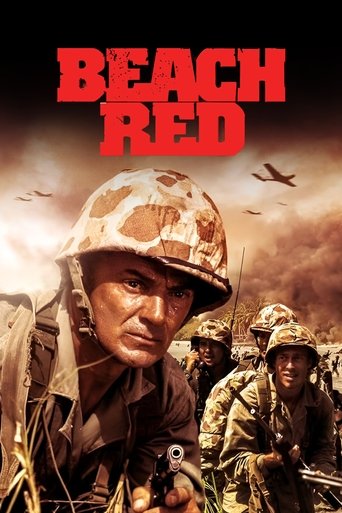
Beach Red (1967)
IT'S HIM OR YOU BABY!
American troops storm ashore on a Japanese-held island and push inland while their enemies plan a counterattack in this look at warfare. Soldiers on both sides are haunted by memories of home and the horrifying, sickening images they find in combat.
- Date of release
- 1967-08-03
- TMDB
- 6.5 / 10 (35)
- Runtime
- 1h 43m
- Genres
- War, Drama
- Director
- Cornel Wilde
Casting
- Cornel Wilde — Capt. MacDonald / Narrator
- Rip Torn — Gunnery Sgt. Ben Honeywell
- Burr DeBenning — Pvt. Egan
- Patrick Wolfe — Pvt. Joseph Joshua Cliff
- Jean Wallace — Julie MacDonald
- Jaime Sánchez — Pvt. Colombo
- Dale Ishimoto — Capt. Tanaka
- Genki Koyama — Col. Sugiyama
- Gene Blakely — Goldberg
- Michael Parsons — Sgt. Lindstrom
- Norman Pak — Pvt. Nakano
- Dewey Stringer — Pvt. Mouse
Interesting facts
- Filmed in: Philippines
- Awards: 0 · Nominations: 1
Beach Red is a 1967 American war film directed, co-written, produced by, and starring Cornel Wilde. An adaptation of the novella of the same title by Peter Bowman, the film depicts a landing by the United States Marine Corps on an unnamed Japanese-held Pacific island. The film and Bowman's novel were based on the author's own experiences in the U.S. Army Corps of Engineers in the Pacific Campaign. It co-stars Rip Torn, Burr DeBenning, Jean Wallace, and Jaime Sánchez.
Production
Beach Red was filmed on location in the Philippines using troops of the Philippine Armed Forces. The sequence of the Japanese dressed in Marine uniforms was inspired by Bowman's book, which mentions Japanese wearing American helmets to infiltrate American lines. There were no known incidents in the Pacific where large numbers of Japanese donned American uniforms and attempted to infiltrate a beachhead.
When seeking assistance from the U.S. Marine Corps, Wilde was told that due to the commitments of the Vietnam War, all the Corps could provide the film was color stock footage taken during the Pacific War. The film provided had deteriorated, so Wilde had to spend a considerable part of the film's budget to restore the film to an acceptable quality in order to blend into the film.
The film's title sequence incorporates various paintings that suddenly segue into the preparations for the landing. The 30-minute opening sequence of the film's graphic depiction of the violence and savagery of war was echoed years later in Steven Spielberg's Saving Private Ryan.
Like Wilde's previous production of The Naked Prey (1965), the film does not use subtitles for non-English dialogue, in this case Japanese.
Read on Wikipedia · Text from Wikipedia, CC BY-SA 4.0. Data from Wikidata.
Recommended
- Merrill's Marauders 1962 · ★ 6.2
- Battleground 1949 · ★ 6.7
- The Young Lions 1958 · ★ 6.7
- The Codes of War 2025 · ★ 6.2
- Paradise Road 1997 · ★ 6.3
- Kokoda 2006 · ★ 6.2
- Operation Pacific 1951 · ★ 6.1
- Devotion 2022 · ★ 7.0
- Lifeboat 1944 · ★ 7.4
- Attack Force Z 1982 · ★ 5.9
- The Longest Day 1962 · ★ 7.6
- Overlord 1975 · ★ 6.8