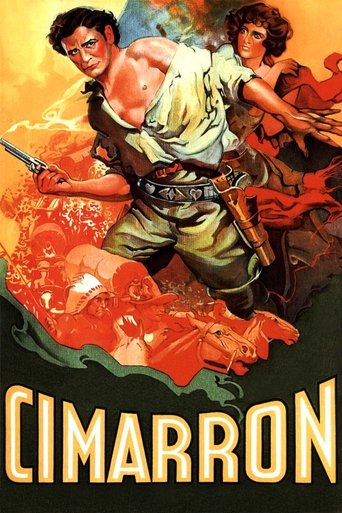
Cimarron (1931)
Terrific as all creation!
When the government opens up the Oklahoma territory for settlement, restless Yancey Cravat claims a plot of the free land for himself and moves his family there from Wichita. A newspaperman, lawyer, and just about everything else, Cravat soon becomes a leading citizen of the boom town of Osage. Once the town is established, however, he begins to feel confined once again, and heads for the Cherokee Strip, leaving his family behind. During this and other absences, his wife Sabra must learn to take care of herself and soon becomes prominent in her own right.
- Date of release
- 1931-01-26
- TMDB
- 5.5 / 10 (162)
- Runtime
- 2h 3m
- Genres
- Western, Drama
- Director
- Wesley Ruggles
Casting
- Richard Dix — Yancey Cravat
- Irene Dunne — Sabra Cravat
- Estelle Taylor — Dixie Lee
- Nance O'Neil — Felice Venable
- William Collier Jr. — The Kid
- Roscoe Ates — Jesse Rickey (as Rosco Ates)
- George E. Stone — Sol Levy
- Stanley Fields — Les Yountis
- Robert McWade — Louis Hefner
- Edna May Oliver — Mrs. Tracy Wyatt
- Judith Barrett — Donna Cravat (as Nancy Dover)
- Eugene Jackson — Isaiah
Interesting facts
- Based on: Cimarron
- Awards: 4 · Nominations: 7. Including: Academy Award for Best Writing, Adapted Screenplay; Academy Award for Best Production Design; Academy Award for Best Picture; National Board of Review: Top Ten Films
Cimarron is a 1931 American pre-Code epic Western film starring Richard Dix and Irene Dunne, and directed by Wesley Ruggles. Released by RKO Radio Pictures, it won Academy Awards for Best Picture, Best Adapted Screenplay, and Best Production Design. It is the first of four Westerns to ever win the top honor at the Academy Awards, being followed almost 60 years later by Dances With Wolves in 1990, Unforgiven in 1992, and No Country for Old Men in 2007.
Production
Despite being in the depths of the Great Depression, RKO Radio Pictures invested more than $1.5 million (equivalent to approximately $31.8 million in 2025) into production of Ferber's novel.
Filming began in the summer of 1930 at the Quinn Ranch outside of Los Angeles, California, where the land rush scenes were shot. More than twenty-eight cameramen, and numerous camera assistants and photographers, were used to capture scenes of more than 5,000 costumed extras, covered wagons, buckboards, surreys, and bicyclists as they raced across grassy hills and prairie to stake their claim.
Cinematographer Edward Cronjager planned out every take (that recalled the scenes of Intolerance some fifteen years earlier) in accordance with Ferber's descriptions. In order to film key scenes for this production, RKO purchased 89 acres (36 hectares) in Encino where construction of art director Max Rée's Oscar-winning design of a complete western town and a three-block modern main street were built to represent the fictional Oklahoma boomtown o…
Read on Wikipedia · Text from Wikipedia, CC BY-SA 4.0. Data from Wikidata.
Recommended
- The Man Who Shot Liberty Valance 1962 · ★ 7.8
- Dances with Wolves 1990 · ★ 7.8
- Dead Man 1995 · ★ 7.3
- Open Range 2003 · ★ 7.2
- The Way West 1967 · ★ 6.1
- Wyatt Earp 1994 · ★ 6.8
- Nevada Smith 1966 · ★ 6.7
- News of the World 2020 · ★ 6.9
- Tell Them Willie Boy Is Here 1969 · ★ 5.8
- Comes a Horseman 1978 · ★ 6.0
- The Outlaw Josey Wales 1976 · ★ 7.5
- El Dorado 1966 · ★ 7.4