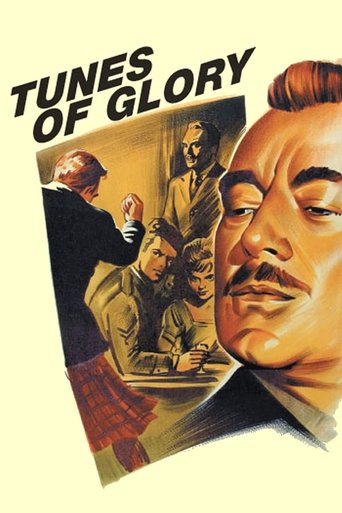
Tunes of Glory (1960)
Colonel Jock Sinclair drank with his men... and sang and danced with them... until that day, when a shot rang out... and he stood alone!
Following World War II in peacetime Scotland, brigade headquarters replaces commanding officer Major Jock Sinclair, a boisterous battalion leader, with the strict, temperamental Lieutenant Colonel Basil Barrow. Resentful toward his replacement, Sinclair undermines Barrow's authority and damages his successor's reputation among the soldiers. Barrow faces an uphill battle in regaining the discipline and respect of his battalion.
- Date of release
- 1960-09-17
- TMDB
- 7.0 / 10 (68)
- Runtime
- 1h 46m
- Genres
- Drama
- Director
- Ronald Neame
Casting
- Alec Guinness — Maj. Jock Sinclair, D.S.O., M.M.
- John Mills — Lt. Col. Basil Barrow (Battalion Commander)
- Dennis Price — Maj. Charles 'Charlie' Scott, M.C. (Battalion Executive Officer)
- Kay Walsh — Mary Titterington
- Susannah York — Morag Sinclair
- John Fraser — Cpl. Piper Ian Fraser
- Gordon Jackson — Capt. Jimmy Cairns, M.C. (Battalion Adjutant)
- Duncan Macrae — Pipe Maj. Duncan MacLean
- Percy Herbert — RSM Riddick
- Allan Cuthbertson — Capt. Eric Simpson
- Paul Whitsun-Jones — Major Dusty Miller
- Gerald Harper — Major Hugo Macmillan
Interesting facts
- Budget: £267.7K
- Based on: Tunes of Glory
- Filmed in: Stirling and Stirling Castle
- Awards: 0 · Nominations: 1
Tunes of Glory is a 1960 British drama film directed by Ronald Neame, starring Alec Guinness and John Mills, featuring Dennis Price, Kay Walsh, John Fraser, Duncan MacRae, Gordon Jackson and Susannah York. It is based on the 1956 novel and screenplay by James Kennaway. The film is a psychological drama focusing on events in a wintry Scottish Highland regimental barracks in the period immediately following the Second World War. Writer Kennaway served with the Gordon Highlanders, and the title refers to the bagpiping that accompanies every important action of the battalion.
Production
The film was initially to be made at Ealing Studios, with Michael Relph as producer and Jack Hawkins playing Sinclair. At the time that it was at Ealing, Kenneth Tynan, then working as a script reader, criticised the first draft screenplay as having "too much army-worship in it". That view was shared by director Alexander Mackendrick. By the time Kennaway rewrote the script, Ealing had lost interest and Hawkins was no longer available.
Accounts differ as to how the leading roles were cast. Mills wrote that he and Guinness "tossed for it", while Guinness recalled that he had originally been offered the role of Barrow but preferred Sinclair. The role of Barrow might have been too close to that of Colonel Nicholson in The Bridge on the River Kwai. Sinclair has been described as "anti-Nicholson".
Tunes of Glory was filmed at Shepperton Studios in London. The sets were designed by the art director Wilfred Shingleton. Establishing location shots were done at Stirling Castle in Stirling, Scotland. Stirling Castle is the Regimental Headquarters of the Argyll and Sutherland Highlanders but, in fact, James Kennaway served with the Gordon Highlanders.
Director Ronald Neame had worked with Guinness on The Horse's Mouth (1958), and a number of other participants were also involved in both films, including actress Kay Walsh, cinematographer Arthur Ibbetson and editor Anne V. Coates. The film was Susannah York's film debut.
Original music was composed by Malcolm Arnold, who also wrote the music for The Bridge on the River Kwai.
Read on Wikipedia · Text from Wikipedia, CC BY-SA 4.0. Data from Wikidata.
Recommended
- The Way Ahead 1944 · ★ 6.5
- The Guns of Navarone 1961 · ★ 7.3
- Barry Lyndon 1975 · ★ 8.0
- Beau Geste 1939 · ★ 7.0
- The Last Rifleman 2023 · ★ 6.6
- Seven Days in May 1964 · ★ 7.3
- Battle of Britain 1969 · ★ 6.8
- Empire of the Sun 1987 · ★ 7.5
- The Hill 2023 · ★ 7.7
- Since You Went Away 1944 · ★ 6.6
- On Dangerous Ground 1951 · ★ 6.7
- The Court-Martial of Billy Mitchell 1955 · ★ 6.8