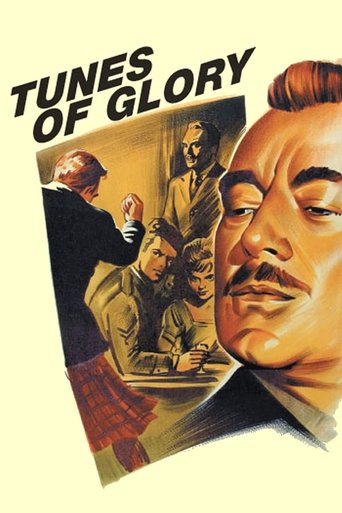
Whisky y gloria (1960)
Tunes of Glory
Después de haber dedicado su vida al ejército escocés, el Mayor Jock Sinclair decide retirarse. Pero su sustituto, un comandante austero y rígido, no está dispuesto a consentir la relajación de disciplina que se ha extendido en el regimiento durante el mando de Sinclair. (FILMAFFINITY)
- Fecha de estreno
- 1960-09-17
- TMDB
- 7.0 / 10 (69)
- Duración
- 1 h 47 min
- Géneros
- Drama
- Director
- Ronald Neame
Reparto
- Alec Guinness — Maj. Jock Sinclair, D.S.O., M.M.
- John Mills — Lt. Col. Basil Barrow (Battalion Commander)
- Dennis Price — Maj. Charles 'Charlie' Scott, M.C. (Battalion Executive Officer)
- Kay Walsh — Mary Titterington
- Susannah York — Morag Sinclair
- John Fraser — Cpl. Piper Ian Fraser
- Gordon Jackson — Capt. Jimmy Cairns, M.C. (Battalion Adjutant)
- Duncan Macrae — Pipe Maj. Duncan MacLean
- Percy Herbert — RSM Riddick
- Allan Cuthbertson — Capt. Eric Simpson
- Paul Whitsun-Jones — Major Dusty Miller
- Gerald Harper — Major Hugo Macmillan
Curiosidades
- Presupuesto: 267,7 mil GBP
- Basada en: Tunes of Glory
- Rodada en: Stirling y Castillo de Stirling
- Premios: 0 · Nominaciones: 1
Tunes of Glory is a 1960 British drama film directed by Ronald Neame, starring Alec Guinness and John Mills, featuring Dennis Price, Kay Walsh, John Fraser, Duncan MacRae, Gordon Jackson and Susannah York. It is based on the 1956 novel and screenplay by James Kennaway. The film is a psychological drama focusing on events in a wintry Scottish Highland regimental barracks in the period immediately following the Second World War. Writer Kennaway served with the Gordon Highlanders, and the title refers to the bagpiping that accompanies every important action of the battalion.
Production
The film was initially to be made at Ealing Studios, with Michael Relph as producer and Jack Hawkins playing Sinclair. At the time that it was at Ealing, Kenneth Tynan, then working as a script reader, criticised the first draft screenplay as having "too much army-worship in it". That view was shared by director Alexander Mackendrick. By the time Kennaway rewrote the script, Ealing had lost interest and Hawkins was no longer available.
Accounts differ as to how the leading roles were cast. Mills wrote that he and Guinness "tossed for it", while Guinness recalled that he had originally been offered the role of Barrow but preferred Sinclair. The role of Barrow might have been too close to that of Colonel Nicholson in The Bridge on the River Kwai. Sinclair has been described as "anti-Nicholson".
Tunes of Glory was filmed at Shepperton Studios in London. The sets were designed by the art director Wilfred Shingleton. Establishing location shots were done at Stirling Castle in Stirling, Scotland. Stirling Castle is the Regimental Headquarters of the Argyll and Sutherland Highlanders but, in fact, James Kennaway served with the Gordon Highlanders.
Director Ronald Neame had worked with Guinness on The Horse's Mouth (1958), and a number of other participants were also involved in both films, including actress Kay Walsh, cinematographer Arthur Ibbetson and editor Anne V. Coates. The film was Susannah York's film debut.
Original music was composed by Malcolm Arnold, who also wrote the music for The Bridge on the River Kwai.
Leer en Wikipedia · Texto de Wikipedia, CC BY-SA 4.0. Datos de Wikidata.
Recomendadas
- Hacia adelante 1944 · ★ 6.5
- Beau Geste 1939 · ★ 7.0
- Barry Lyndon 1975 · ★ 8.0
- El último soldado 2023 · ★ 6.6
- Siete días de mayo 1964 · ★ 7.3
- A bayoneta calada 1951 · ★ 6.5
- La batalla de Inglaterra 1969 · ★ 6.8
- El imperio del sol 1987 · ★ 7.5
- Desde que te fuiste 1944 · ★ 6.6
- El viaje de Rickey Hill 2023 · ★ 7.7
- El señor de las moscas 1963 · ★ 6.7
- Jimmy's Hall 2014 · ★ 6.7