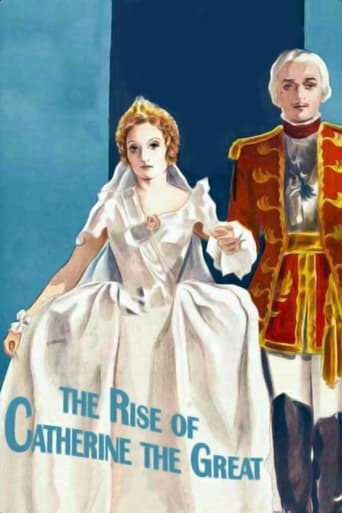
The Rise of Catherine the Great (1934)
The more he hated her, the more she loved him...this girl of MANY loves who rose to rule a hundred million souls but could not govern her own heart.
The woman who will become Catherine the Great marries into the Russian royal family when she weds Grand Duke Peter, the nephew of Empress Elizabeth. Although the couple has moments of contentment, Peter's cruel and erratic behavior causes a rift between him and Catherine. Mere months after Peter succeeds his aunt as the ruler of Russia, a revolt is brewing, and Catherine is poised to ascend to the throne as the country's new empress.
- Date of release
- 1934-02-09
- TMDB
- 5.8 / 10 (22)
- Runtime
- 1h 35m
- Genres
- Drama, History
- Director
- Paul Czinner
Casting
- Douglas Fairbanks Jr. — Grand Duke Peter
- Elisabeth Bergner — Catherine
- Flora Robson — Empress Elisabeth
- Gerald du Maurier — Lecocq
- Irene Vanbrugh — Princess Anhalt-Zerbst
- Joan Gardner — Katushienka
- Dorothy Hale — Countess Olga
- Diana Napier — Countess Vorontzova
- Griffith Jones — Grigory Orlov
- Gibb McLaughlin — Bestujhev
- Clifford Heatherley — Ogarev
- Laurence Hanray — Goudovitch
Interesting facts
The Rise of Catherine the Great is a 1934 British historical film about the rise to power of Catherine the Great, Empress of Russia. Produced by Alexander Korda and directed by Paul Czinner, the screenplay was based on Lajos Bíró and Melchior Lengyel's 1912 play The Czarina and was co-written by Arthur Wimperis and Marjorie Deans. It stars Elisabeth Bergner as Catherine, Douglas Fairbanks Jr. as Grand Duke Peter, and Flora Robson as Empress Elizabeth.
Production
After the success of his film The Private Life of Henry VIII (1932), producer Alexander Korda made a deal with United Artists and decided to make another film about the personal life of a historical figure. His next production would be a film adaptation of the 1912 Hungarian play titled The Czarina (A carno), written by Lajos Bíró and Melchior Lengyel, the screenwriters of The Private Life of Henry VIII.
In 1933, German actress Elisabeth Bergner and her husband, Hungarian director Paul Czinner, went to England and signed a contract with Korda's London Films. Bergner was cast as Catherine and she selected her husband as her director. Charles Laughton recommended Flora Robson for the role of Empress Elizabeth of Russia.
Korda was not satisfied with the way Czinner was directing the other actors, so he intervened and directed several senes himself. In a documentary about Korda, Elisabeth Bergner said, "Well, he wasn't a very good director and suddenly after Henry he thought he was, and he could butt in and say it should be done this way or another way and forgot our contract which didn't allow him this. So we had fights. . . ." Douglas Fairbanks Jr.
Fairbanks Jr. described Bergner as "charming to work with, full of special mannerisms and meticulously honed tricks of the trade. She timed her scenes to the second. […] She was technically almost unsurpassed." He also said that Robson, in "her first major film role, made it perfectly clear to all that she would become one of the finest actresses of the day", and lauded Du Maurier's portrayal of "the Czar's witty French valet" as "a glistening mo…
Read on Wikipedia · Text from Wikipedia, CC BY-SA 4.0. Data from Wikidata.
Recommended
- Munich - The Edge of War 2021 · ★ 6.9
- Victoria & Abdul 2017 · ★ 6.9
- Richard Jewell 2019 · ★ 7.4
- Official Secrets 2019 · ★ 7.2
- The Scarlet and the Black 1983 · ★ 7.1
- The Last Emperor 1987 · ★ 7.6
- Mary 2024 · ★ 6.3
- Experimenter 2015 · ★ 6.5
- Goya's Ghosts 2006 · ★ 6.6
- Julius Caesar 1953 · ★ 7.1
- One Night with the King 2006 · ★ 6.7
- Snow Flower and the Secret Fan 2011 · ★ 6.1