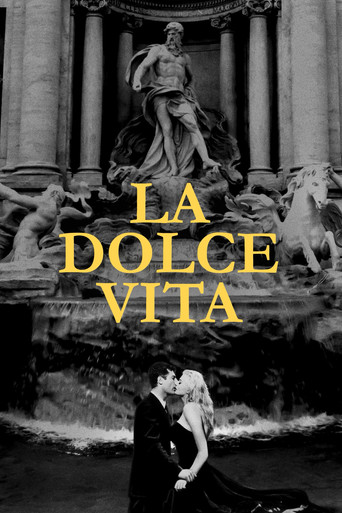
La Dolce Vita (1960)
La dolce vita
The world’s most talked about movie today!
Episodic journey of journalist Marcello who struggles to find his place in the world, torn between the allure of Rome's elite social scene and the stifling domesticity offered by his girlfriend, all the while searching for a way to become a serious writer.
- Date of release
- 1960-02-05
- TMDB
- 8.0 / 10 (2111)
- Runtime
- 2h 54m
- Genres
- Comedy, Drama
- Director
- Federico Fellini
Casting
- Marcello Mastroianni — Marcello Rubini
- Anita Ekberg — Sylvia
- Anouk Aimée — Maddalena
- Yvonne Furneaux — Emma
- Magali Noël — Fanny
- Alain Cuny — Steiner
- Annibale Ninchi — Marcello's father
- Walter Santesso — Paparazzo
- Valeria Ciangottini — Paola
- Riccardo Garrone — Riccardo
- Ida Galli — Debutante of the year
- Audrey McDonald — Jane
Interesting facts
- Box office: $19.5M
- Filmed in: Rome, Trevi Fountain, and Viale Bligny
- Awards: 2 · Nominations: 4. Including: Academy Award for Best Costume Design, Black-and-White; Palme d'Or
La Dolce Vita is a 1960 satirical comedy-drama film directed by Federico Fellini and written by Fellini, Ennio Flaiano, Tullio Pinelli, and Brunello Rondi. The film stars Marcello Mastroianni as Marcello Rubini, a tabloid journalist who, over seven days and nights, journeys through the "sweet life" of Rome in a fruitless search for love and happiness. The screenplay can be divided into a prologue, seven major episodes interrupted by an intermezzo, and an epilogue, according to the most common interpretation.
Production
In various interviews, Fellini said that the film's inspiration was the fashionable ladies' sack dress, because of what the dress could hide beneath it. Brunello Rondi, Fellini's co-screenwriter and long-time collaborator, confirmed this view explaining that "the fashion of women's sack dresses which possessed that sense of luxurious butterflying out around a body that might be physically beautiful but not morally so; these sack dresses struck Fe…
Credit for the creation of Steiner, the intellectual who kills himself after shooting his two children, goes to co-screenwriter Tullio Pinelli. Having gone to school with Italian novelist Cesare Pavese, Pinelli had closely followed the writer's career and felt that his over-intellectualism had become emotionally sterile, leading to his suicide in a Turin hotel in 1950.
The "false miracle" alludes to the 1958 investigation discounting the claims of two children to have been visited by the Madonna in a farm at Maratta Alta, near Terni. The "dead sea monster" alludes to the Montesi affair, in which the dead body of 21 year old Wilma Montesi was discovered on a beach in April 1953.
La Dolce Vita marks the first collaboration between Fellini and Mastroianni. On November 4, 1977 in an interview on The Dick Cavett Show, Mastroianni recalled their first encounter. According to Mastroianni, Fellini told him that the producer wanted Paul Newman for the lead role, but that Fellini considered Newman too beautiful, while Mastroianni was "the face of normal." Mastroianni, somewhat embarrassed, requested to read the script before agre…
Most of the film was shot at the Cinecittà Studios in Rome. Set designer Piero Gherardi created over eighty locations, including the Via Veneto, the dome of Saint Peter's with the staircase leading up to it, and various nightclubs. However, other sequences were shot on location such as the party at the aristocrats' castle filmed in the real Bassano di Sutri palace north of Rome.
Read on Wikipedia · Text from Wikipedia, CC BY-SA 4.0. Data from Wikidata.
Recommended
- Hereafter 2010 · ★ 6.1
- Ghostlight 2024 · ★ 7.1
- I Vitelloni 1953 · ★ 7.7
- The Great Beauty 2013 · ★ 7.5
- Interiors 1978 · ★ 6.8
- Ugly, Dirty and Bad 1976 · ★ 7.5
- Ovosodo 1997 · ★ 7.2
- Another Year 2010 · ★ 7.0
- Death of a Superhero 2011 · ★ 6.9
- Dolphin Tale 2011 · ★ 6.9
- Bob Trevino Likes It 2025 · ★ 7.5
- Killer's Kiss 1955 · ★ 6.3