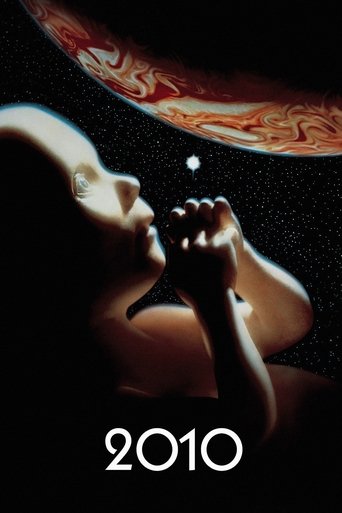
2010 (1984)
In the very near future, a small group of Americans and Russians set out on the greatest adventure of them all...to see if there is life beyond the stars.
While planet Earth poises on the brink of nuclear self-destruction, a team of Russian and American scientists aboard the Leonov hurtles to a rendezvous with the still-orbiting Discovery spacecraft and its sole known survivor, the homicidal computer HAL.
- Date of release
- 1984-12-06
- TMDB
- 6.7 / 10 (1149)
- Runtime
- 1h 56m
- Genres
- Thriller, Science Fiction
- Director
- Peter Hyams
- Collection
- The Space Odyssey Series
Casting
- Roy Scheider — Dr. Heywood Floyd
- John Lithgow — Dr. Walter Curnow
- Helen Mirren — Tanya Kirbuk
- Bob Balaban — Dr. R. Chandra
- Keir Dullea — Dr. David Bowman
- Douglas Rain — HAL 9000 (voice)
- Madolyn Smith Osborne — Caroline Floyd
- Savely Kramarov — Dr. Vladimir Rudenko
- Taliesin Jaffe — Christopher Floyd
- James McEachin — Victor Milson
- Mary Jo Deschanel — Betty Fernandez
- Elya Baskin — Maxim Brailovsky
Interesting facts
- Box office: $40.4M
- Budget: $28M
- Earned 1.4× its budget
- Based on: 2010: Odyssey Two
- Filmed in: New Mexico
- Awards: 1 · Nominations: 5. Including: Hugo Award for Best Dramatic Presentation
2010: The Year We Make Contact is a 1984 American science fiction film written, produced, shot, and directed by Peter Hyams. The film is a sequel to Stanley Kubrick's 1968 film 2001: A Space Odyssey and adapts Arthur C. Clarke's 1982 novel 2010: Odyssey Two. 2010 follows a joint American and Soviet crew that is sent to Jupiter to discover the reason behind the failure of the Discovery One mission. The film stars Roy Scheider, Helen Mirren, Bob Balaban, and John Lithgow, along with Keir Dullea and Douglas Rain, who reprise their roles from the previous film.
Production
When Clarke published his novel 2010: Odyssey Two in 1982, he telephoned Stanley Kubrick, and jokingly said, "Your job is to stop anybody [from] making it [into a film] so I won't be bothered." Metro-Goldwyn-Mayer subsequently worked out a contract to make a film adaptation, but Kubrick had no interest in directing it. However, Peter Hyams was interested and contacted both Clarke and Kubrick for their blessings:
I had a long conversation with Stanley and told him what was going on. If it met with his approval, I would do the film; and if it didn't, I wouldn't. I certainly would not have thought of doing the film if I had not gotten the blessing of Kubrick. He's one of my idols; simply one of the greatest talents that's ever walked the Earth. He more or less said, 'Sure. Go do it. I don't care.' And another time he said, 'Don't be afraid.
While he was writing the screenplay in 1983, Hyams (in Los Angeles) began communicating with Clarke (in Sri Lanka) via the then-pioneering medium of e-mail using Kaypro II computers and direct-dial modems. They discussed the planning and production of the film almost daily using this method, and their informal, often humorous correspondence was published in 1984 as The Odyssey File.
Principal photography on the film began in February 1984 for a 71-day schedule. Most of the film was shot on MGM's soundstages in Culver City, California, with the exception of a week of location work in Washington, DC, Rancho Palos Verdes, California, and at the Very Large Array in New Mexico.
Video Image (also known as VIFX), which would go on to work on a number of major pictures and briefly become 20th Century Fox's in-house visual effects studio, did its first work on this film, designing the video screen graphics.
Read on Wikipedia · Text from Wikipedia, CC BY-SA 4.0. Data from Wikidata.
Recommended
- 2001: A Space Odyssey 1968 · ★ 8.0
- Star Trek Beyond 2016 · ★ 6.8
- Star Trek Into Darkness 2013 · ★ 7.3
- Star Trek 2009 · ★ 7.4
- Star Trek II: The Wrath of Khan 1982 · ★ 7.5
- Star Trek: Insurrection 1998 · ★ 6.5
- Star Trek: The Motion Picture 1979 · ★ 6.5
- Space/Time 2025 · ★ 5.8
- Star Wars: The Rise of Skywalker 2019 · ★ 6.2
- Stargate SG-1: Children of the Gods 2009 · ★ 7.2
- Solo: A Star Wars Story 2018 · ★ 6.5
- The Black Hole 1979 · ★ 5.8