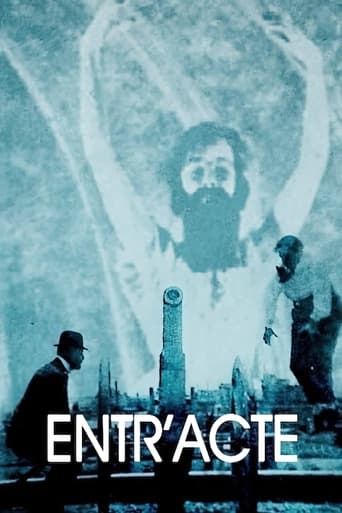
Entr'acte (1924)
Stop-motion photography blends with extreme slow-motion in Clair's first and most dada film, composed of a series of zany, interconnected scenes. We witness a rooftop chess match between Marcel Duchamp and Man Ray, a hearse pulled by a camel (and chased by its pallbearers) and a dizzying roller coaster finale. A film of contradictions and agreements.
キャスト
- Jean Börlin — Hunter / Magician
- Inge Frïss — Bearded ballet dancer
- Marcel Duchamp — Chess player, black set
- Man Ray — Chess player, white set
- Francis Picabia — A man loading the cannon
- Darius Milhaud
- Marcel Achard — A man following the hearse (uncredited)
- Georges Auric — A man following the hearse (uncredited)
- Georges Charensol — A man following the hearse (uncredited)
- Georges Lacombe — A man following the hearse (uncredited)
- Roger Le Bon — A man following the hearse (uncredited)
- Jean Mamy — A man following the hearse (uncredited)
豆知識
Entr'acte is a silent French Dada short film directed by René Clair. It premiered on 4 December 1924 at the Théâtre des Champs-Élysées in Paris as a prologue and entr'acte for the Ballets Suédois production of Relâche, based on a book by Francis Picabia, which had settings by Picabia, was produced by Rolf de Maré, and was choreographed by Jean Börlin. The music for both the ballet and the film was composed by Erik Satie.
Production and release
For this production, the Dadaists collaborating on the project invented a new mode of production: instantanéisme. The complete film runs for about 20 minutes and uses such techniques as watching people run in slow motion, watching things happen in reverse, looking at a ballet dancer from underneath, watching an egg over a fountain of water get shot and instantly become a bird, and watching people disappear.
The "Prologue" section runs about 90 seconds (though time indications are approximate, as film and music techniques at the time of the premiere did not allow accurate timing). It was played at the beginning of the ballet, right after the "little overture" ("Ouverturette"), and before the curtain was raised ("Rideau"). The music to this part of the film is called "Projectionnette", and is included as the 2nd item in the Relâche partition.
The "Entr'acte" section runs about 18 minutes and 40 seconds. It was played between the two acts of the ballet. The score for this part of the film is not included in the Relâche partition, but was written down by Satie in a separate score, titled "Cinéma".
In 1974, the film was shown at the Cannes Film Festival.
The film was included on the Criterion Collection DVD of Clair's À Nous la Liberté (1931).
Wikipediaで続きを読む · テキストはWikipedia、CC BY-SA 4.0。データはWikidata。
おすすめ
- 神様メール 2015 · ★ 6.6
- ウイークエンド 1967 · ★ 6.9
- Destino 2003 · ★ 7.2
- One Hundred and One Nights 1995 · ★ 6.1
- The Severed Heads 1957 · ★ 6.1
- Themroc 1973 · ★ 6.4
- Parade 1974 · ★ 5.9
- Mr. Peek-a-Boo 1951 · ★ 6.1
- カーミットのどろんこ大冒険 2002 · ★ 5.8
- ブルジョワジーの秘かな愉しみ 1972 · ★ 7.4
- ガンダーラ 1987 · ★ 6.9
- Femmes Fatales 1976 · ★ 6.1