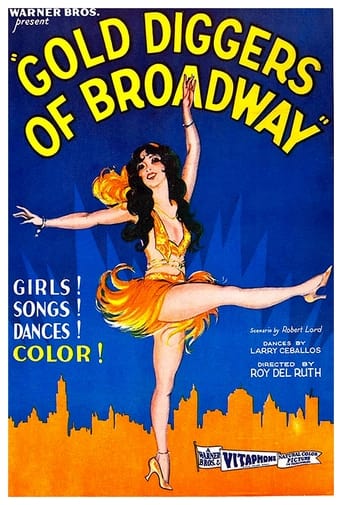
Gold Diggers of Broadway (1929)
Girls! Songs! Dances! Color!
Three Broadway chorus girls seek rich husbands.
- Date of release
- 1929-08-30
- TMDB
- 7.7 / 10 (3)
- Runtime
- 1h 41m
- Genres
- Comedy, Music
- Director
- Roy Del Ruth
Casting
- Nancy Welford — Jerry
- Conway Tearle — Stephen Lee
- Winnie Lightner — Mabel
- Ann Pennington — Ann Collins
- Lilyan Tashman — Eleanor Montgomery
- William Bakewell — Wally Saunders
- Nick Lucas — Nick
- Helen Foster — Violet Dayne
- Albert Gran — James Blake
- Neely Edwards — Stage Manager
- Gertrude Short — Topsy
- Julia Swayne Gordon — Cissy Gray
Interesting facts
Gold Diggers of Broadway is a 1929 American sound (All-Talking) pre-Code musical comedy film directed by Roy Del Ruth and starring Winnie Lightner and Nick Lucas. Distributed by Warner Bros. Pictures, the film is the second all-talking, all-Technicolor feature-length film.
Production
The song "Painting the Clouds with Sunshine" was originally the main theme for the film. After Nick Lucas signed on, the film was spotted as a potential hit, and "Tiptoe Through the Tulips" was written to enlarge the film; Darryl Zanuck, who hired Lucas, provided an extra production number for the tune. A greatly different version was later performed by the camp singer Tiny Tim, who recorded it as a novelty, accompanying himself on ukulele.
The production numbers "Painting the Clouds with Sunshine" and "Tiptoe Through the Tulips" both start on a smaller set and move to a larger one. To change between sets while the song was sung and create a seamless transition, instead of using a curtain, a shot of a stagehand was shown throwing a sparking electric lighting switch which darkens one scene out and fades in another. The basic storyline was modified and reused in later Warner Bros.
The theater set used in Gold Diggers of Broadway was also used in other Warner Bros. and First National movies, such as Paris, On with the Show!, Is Everybody Happy?, Sally, Footlights and Fools, and No, No, Nanette, as well as other set pieces and costumes that were used as late as 1930.
Efrus & Bennett published a photoplay novel of Gold Diggers of Broadway, based on Hopwood's early screenplay, novelized by Eve Bernstein.
Gold Diggers of Broadway was filmed in Technicolor. According to Herbert Kalmus, the co-founder and President of the company, the system Technicolor used at that time was a subtractive imbibition two-color process introduced in 1928 that utilized filters and a normal-thickness dye-transfer print, as opposed to two prints cemented together, as had previously been the case. Warner Bros.
Read on Wikipedia · Text from Wikipedia, CC BY-SA 4.0. Data from Wikidata.
Recommended
- The Big Store 1941 · ★ 6.3
- Love Happy 1949 · ★ 5.8
- Footlight Parade 1933 · ★ 6.8
- A Song Is Born 1948 · ★ 6.5
- The Rutles: All You Need Is Cash 1978 · ★ 6.8
- The Cocoanuts 1929 · ★ 6.5
- Animal Crackers 1930 · ★ 6.9
- Babes in Arms 1939 · ★ 6.4
- A Day at the Races 1937 · ★ 7.1
- At the Circus 1939 · ★ 6.4
- Make Mine Music 1946 · ★ 5.8
- Arlo the Alligator Boy 2021 · ★ 6.8