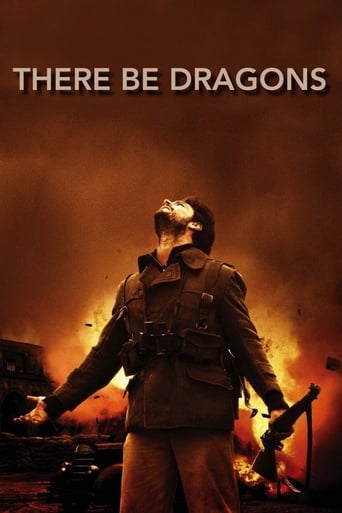
There Be Dragons (2011)
Even saints have a past.
Arising out of the horror of the Spanish Civil War, a candidate for canonization is investigated by a journalist who discovers his own estranged father had a deep, dark and devastating connection to the saint's life.While researching the life of Josemaria Escriva, the controversial founder of Opus Dei, the young journalist Robert uncovers hidden stories of his estranged father Manolo, and is taken on a journey through the dark, terrible secrets of his family’s past.
- Date of release
- 2011-03-25
- TMDB
- 5.1 / 10 (147)
- Runtime
- 1h 52m
- Genres
- War, History, Drama
- Director
- Roland Joffé
Casting
- Charlie Cox — Josemaría
- Dougray Scott — Robert
- Wes Bentley — Manolo
- Olga Kurylenko — Ildiko
- Rodrigo Santoro — Oriol
- Golshifteh Farahani — Leila
- Jordi Mollà — Don Jose
- Ana Torrent — Dona
- Derek Jacobi — Honorio
- Geraldine Chaplin — Abileyza
- Charles Dance — Solono
- Lily Cole — Aline
Interesting facts
- Filmed in: Buenos Aires
There Be Dragons is a 2011 historical epic war drama film written and directed by Roland Joffé. Set during the Spanish Civil War of the 1930s, it features themes such as betrayal, love and hatred, forgiveness, friendship, and finding meaning in everyday life. It includes the story of soldiers, a journalist, his father, and a real-life priest, Josemaría Escrivá, the founder of Opus Dei, who was canonized as a Roman Catholic saint.
Production
The film was produced by Roland Joffé (also the director), Guy J. Louthan, and Opus Dei members Ignacio G. Sancha and Ignacio Núñez.
Sancha and Núñez created a fund that has resources from private equity funds and other institutional and private investors. Spanish media company Antena 3, owner of the first private television network in Spain, also funded the film. The production services were provided by Morena Films of Spain and Historias Cinematográficas of Argentina.
The New York Times, which called the film a religious epic, reported that a different script written by Barbara Nicolosi was first offered to Hugh Hudson and Alejandro González Iñárritu, who both turned it down. Joffé also initially turned down the offer to work as the film's director. "But he said he reconsidered after he saw a video of Escrivá answering a question from a Jewish girl who wanted to convert to Catholicism.
In the press conference held in Buenos Aires on 24 August 2009, Sancha stated that "our role is to create a space of free creativity for Roland, who has absolute free hand as a filmmaker. The value of the project lies in the fact that someone completely independent from the subject or the Catholic Church, and who is an agnostic, is portraying Josemaría according to his own view."
Director Roland Joffé wanted to share Josemaria's story on film because he admired the way the saint's faith influenced his day-to-day life. "Josemaria’s idea was that you find sanctity; you find your religious experience not only in liturgical things or in the church, but in the very act of living in your daily life," Joffé reported to CBN.com.
Read on Wikipedia · Text from Wikipedia, CC BY-SA 4.0. Data from Wikidata.
Recommended
- Outlaws - For Greater Glory 2012 · ★ 7.0
- Behold a Pale Horse 1964 · ★ 6.0
- Braveheart 1995 · ★ 7.9
- Field of Lost Shoes 2015 · ★ 6.1
- Glory 1989 · ★ 7.5
- Salvador 1986 · ★ 7.0
- Resistance 2020 · ★ 7.0
- The Kill Team 2019 · ★ 6.5
- Beasts of No Nation 2015 · ★ 7.6
- Firebrand 2024 · ★ 6.3
- The Killing Fields 1984 · ★ 7.5
- Nuremberg 2025 · ★ 7.6