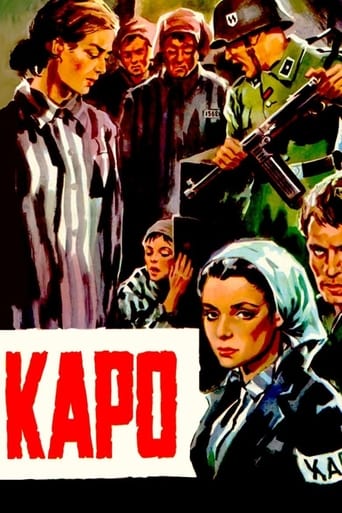
Kapo (1960)
Kapò
Determined to survive at any price, Edith, a young Jewish woman deported to an extermination camp, manages to survive by accepting the role of kapo, a privileged prisoner whose mission is to ruthlessly guard other prisoners.
- Date of release
- 1960-09-27
- TMDB
- 6.9 / 10 (82)
- Runtime
- 1h 57m
- Genres
- Drama, War
- Director
- Gillo Pontecorvo
Casting
- Susan Strasberg — Edith
- Laurent Terzieff — Sascha
- Emmanuelle Riva — Terese
- Didi Perego — Sofia
- Gianni Garko — Karl
- Annabella Besi — Carole
- Graziella Galvani — Isabelle
- Paola Pitagora — Georgette
- Eleonora Bellinzaghi
- Bruno Scipioni
- Dragomir Felba
- Mira Dinulović
Interesting facts
- Filmed in: Zagreb and Yugoslavia
- Awards: 0 · Nominations: 2
Kapò is a 1960 historical war drama film directed and co-written by Gillo Pontecorvo. It was one of the first narrative films to deal explicitly with the subject of the Holocaust, with graphic depictions of Nazi concentration camps which made it controversial at the time. A co-production of Italian, French, and Yugoslavian companies, the film stars American actress Susan Strasberg, along with Laurent Terzieff, Emmanuelle Riva, Didi Perego and Gianni Garko. The title refers to a prisoner functionary in the Nazi concentration camps.
Production
Pontecorvo and his screenwriter Franco Solinas were inspired to make the film after reading Primo Levi's memoir If This Is a Man. The writing process was a tense one, as Pontecorvo and Solinas had contrasting ideas on what the film should be - Pontecorvo believed Solinas' script was too melodramatic and nearly broke off their partnership before the intervention of producer Franco Cristaldi.
Claudia Cardinale was considered for the lead role before Susan Strasberg, who was known for playing Anne Frank in the Broadway play The Diary of Anne Frank, was cast. This later caused problem on set, because the American actress did not speak Italian, and Pontecorvo had to communicate with her through an interpreter.
Filming took place at Jadran Studios in Zagreb. The culture clash between the Italian and Yugoslavian crews also caused problems. Pontecorvo was forced to work with a Yugoslavian cinematographer, Aleksandar Sekulović, whose smooth, "Hollywood-style" photography he found inappropriate for the subject matter, much preferring the vérité-style photography by the Italian second unit cameramen.
Read on Wikipedia · Text from Wikipedia, CC BY-SA 4.0. Data from Wikidata.
Recommended
- Look to the Sky 1993 · ★ 6.5
- The World Will Tremble 2025 · ★ 7.5
- Adam Resurrected 2008 · ★ 6.1
- The Boy in the Woods 2023 · ★ 7.0
- The Zone of Interest 2023 · ★ 7.0
- The Courageous Heart of Irena Sendler 2009 · ★ 7.4
- The Truce 1997 · ★ 6.1
- The Grey Zone 2001 · ★ 6.6
- God on Trial 2008 · ★ 6.8
- Waiting for Anya 2020 · ★ 6.3
- Escape from Sobibor 1987 · ★ 7.2
- Schindler's List 1993 · ★ 8.6