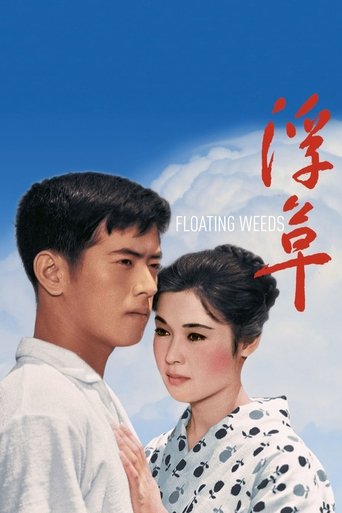
Floating Weeds (1959)
浮草
A theater troupe master's visit with his old flame unintentionally sets off a chain of unexpected events with devastating consequences.
- Date of release
- 1959-11-17
- TMDB
- 7.5 / 10 (209)
- Runtime
- 1h 55m
- Genres
- Drama
- Director
- Yasujirō Ozu
Casting
- Ganjirō Nakamura II — Komajuro Arashi
- Machiko Kyō — Sumiko
- Ayako Wakao — Kayo
- Hiroshi Kawaguchi — Kiyoshi
- Haruko Sugimura — Oyoshi
- Hitomi Nozoe — Aiko
- Chishū Ryū — Theatre Owner
- Kōji Mitsui — Kichinosuke
- Haruo Tanaka — Yatazo
- Yosuke Irie — Sugiyama
- Hikaru Hoshi — Kimura
- Mantarō Ushio — Sentaro
Interesting facts
Floating Weeds is a 1959 Japanese drama film directed and co-written by Yasujirō Ozu, starring Nakamura Ganjirō II, Machiko Kyō, Hiroshi Kawaguchi and Haruko Sugimura. It is a remake of Ozu's own black-and-white silent film A Story of Floating Weeds (1934), and follows a troupe of kabuki actors in a small seaside town, where the troupe's aging lead actor has an adult son with his former mistress.
Production
Floating Weeds, Ozu's only film for Daiei, was produced at the studio's urging after he completed Good Morning (1959), which had fulfilled the director's contractual obligation to complete one film per year for Shochiku. Ozu had intended to remake A Story of Floating Weeds for Shochiku in 1958, retitled A Ham Actor (大根役者 daikon yakusha, "radish actor") and starring Eitarō Shindō and Chikage Awashima as the primary leads, Masami Taura and Ineko Ar…
In a bit of stunt casting, Ozu secured Kōji Mitsui from Shochiku to play Kichinosuke, the character who drives the subplot about the amorous escapades of the troupe's supporting players: the actor (credited as Hideo Mitsui) had portrayed the protagonist's son in the 1934 version of the film. Floating Weeds was Mitsui's seventh and final film for Ozu.
The troupe is seen performing a scene from a play about Chuji Kunisada, a 19th-century historical figure who was romanticised as a forest-dwelling Robin-Hood-like hero in a number of plays, novels, and films. In the scene shown, Kunisada (played by Sumiko) is taking his leave of his faithful companions, Gantetsu and Jōhachi, on Mount Akagi. Wild geese flying south for the winter and crows returning to their nests are used as images of parting.
Despite Nakamura Ganjirō II's fame as a noted star of kabuki theater, he is shown applying full makeup, but not actually filmed onstage, though he is heard off-screen as the audience watches him perform and players backstage lament the show's poor attendance. Nakamura recalled that he and Machiko Kyo got sick with a cold after filming the confrontation scene between their characters in the rain.
Kazuo Miyagawa served as cinematographer for the film, replacing Ozu's favorite cameraman, Yuharu Atsuta. In an interview, Ozu described the film as an experiment in how to bring life to an old fashioned story in a modern setting, and noted that, by working with Miyagawa, he realized that different colors required varying degrees of lighting.
Read on Wikipedia · Text from Wikipedia, CC BY-SA 4.0. Data from Wikidata.
Recommended
- A Story of Floating Weeds 1934 · ★ 7.2
- Drive My Car 2021 · ★ 7.4
- Late Spring 1949 · ★ 8.0
- The Bad Sleep Well 1960 · ★ 7.7
- May December 2023 · ★ 6.6
- Hamlet 1948 · ★ 7.4
- Marriage Story 2019 · ★ 7.7
- Before We Vanish 2017 · ★ 6.5
- The End of Summer 1961 · ★ 7.5
- A Man 2022 · ★ 7.1
- Inheritance 2020 · ★ 6.3
- An Autumn Afternoon 1962 · ★ 7.9