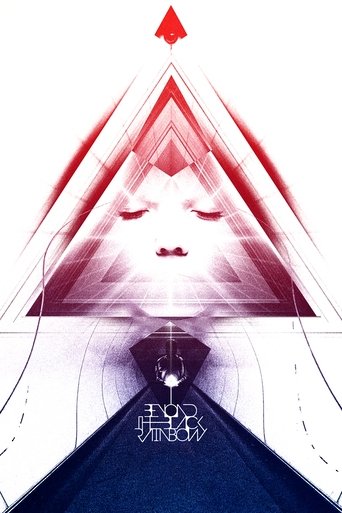
Beyond the Black Rainbow (2010)
Beyond Science. Beyond Sanity. Beyond Control.
In 1983, a young mute woman with psychic abilities is held captive within the Arboria Institute, a secluded futuristic facility overseen by a sinister doctor with an unraveling mind and a growing obsession with her.
- Date of release
- 2010-12-03
- TMDB
- 5.6 / 10 (429)
- Runtime
- 1h 50m
- Genres
- Science Fiction, Horror, Mystery
- Director
- Panos Cosmatos
Casting
- Michael J. Rogers — Barry Nyle
- Eva Bourne — Elena
- Scott Hylands — Mercurio Arboria
- Marilyn Norry — Rosemary Nyle
- Rondel Reynoldson — Margo
- Ryley Zinger — Sentionaut
- Gerry South — Skinny Hesher
- Chris Gauthier — Fat Hesher
- Geoffrey Conder — Mutant
- Ronald Reagan — Self (archive footage)
Interesting facts
- Filmed in: Vancouver
Beyond the Black Rainbow is a 2010 Canadian psychedelic science fiction horror film written and directed by Panos Cosmatos in his feature film debut. It stars Michael Rogers and Eva Allan.
Production
As a child, Cosmatos frequented a video store named Video Attic. During these trips he would browse the horror film section looking at the boxes although he was not allowed to watch such films. During such times he would instead imagine what the film was.
The presence of his parents haunts "every frame of this film", said the Rome-born filmmaker. His father was film director George P. Cosmatos (whose credits include Rambo: First Blood Part II and Cobra), deceased in April 2005, and his mother Swedish sculptor Birgitta Ljungberg-Cosmatos, who died in July 1997 after a lengthy battle with cancer.
Eva Allan, who plays the main female lead, found an acting agent right away after graduating from School Creative which led to her role on this film.
Beyond the Black Rainbow was financed by DVD residuals from Tombstone (1993), directed by Panos' father. The film was shot in three weeks using a modified Panavision 35 mm camera. This was suggested by cinematographer Norm Li, for he noted that Panos' references – mostly films from the '70s and '80s – "were all grainy, colorful, and full of texture", and he felt the 35 mm format was "the only way to shoot."
Beyond the Black Rainbow has been praised for its visual style. Cosmatos declared that his "modernist" use of color was influenced by Michael Mann's Manhunter (1986) and The Keep (1983). The blue hue cinematography – the "night mode" as Cosmatos dubbed it – was inspired by the freezer room scene in John Carpenter's Dark Star (1974).
Read on Wikipedia · Text from Wikipedia, CC BY-SA 4.0. Data from Wikidata.
Recommended
- The Hidden 1987 · ★ 6.9
- Possessor 2020 · ★ 6.4
- Videodrome 1983 · ★ 7.2
- Smile 2022 · ★ 6.7
- Mirrors 2008 · ★ 6.3
- Stonehearst Asylum 2014 · ★ 6.9
- The Void 2016 · ★ 6.0
- Barbarian 2022 · ★ 6.9
- Dressed to Kill 1980 · ★ 6.9
- Crimes of the Future 2022 · ★ 6.0
- Year 10 2024 · ★ 6.2
- Dark City 1998 · ★ 7.3