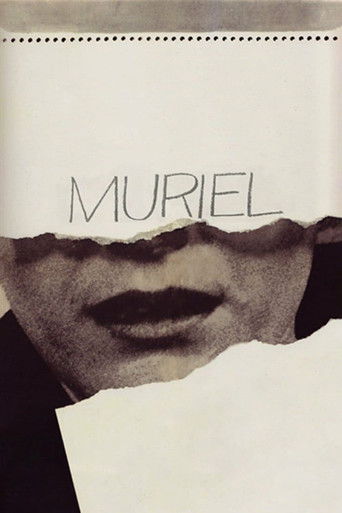
Muriel, or the Time of Return (1963)
Muriel, ou le Temps d'un retour
In the seacoast town of Boulogne, antique furniture saleswoman Hélène lives with her stepson, Bernard, who's back from military duty in Algiers. An old lover of Hélène's comes to visit, Alphonse, with his niece Françoise; he too is back from Algiers, where he ran a café. Bernard speaks of his fiancée, Muriel, whom Hélène has not met. The past is obscured by guilt, misperceptions, and missed possibilities. Appearances deceive, things change. As Hélène and Alphonse try to sort out a renewal, everyone seems off-kilter just enough to hint that all cannot end well.
- Date of release
- 1963-10-01
- TMDB
- 6.9 / 10 (199)
- Runtime
- 1h 57m
- Genres
- Drama
- Director
- Alain Resnais
Casting
- Delphine Seyrig — Hélène Aughain
- Jean-Pierre Kérien — Alphonse Noyard
- Jean-Baptiste Thiérrée — Bernard Aughain
- Nita Klein — Françoise
- Claude Sainval — Roland de Smoke
- Laurence Badie — Claudie
- Martine Vatel — Marie-Dominique, aka Marie-Do
- Philippe Laudenbach — Robert
- Jean Champion — Ernest
- Jean Dasté — L'homme à la chèvre / The Goat Man
- Julien Verdier — Le loueur de chevaux / The Stableman
- Nelly Borgeaud — La femme du couple d'acheteurs
Interesting facts
Muriel is a 1963 French psychological drama film directed by Alain Resnais, and starring Delphine Seyrig, Jean-Pierre Kérien, Jean-Baptiste Thiérrée, and Nita Klein. Its plot follows a middle-aged widow in Boulogne-sur-Mer and her stepson—recently returned from military service in the Algerian War—who are visited by her ex-lover and his new young girlfriend.
Production
Alain Resnais and Jean Cayrol first discussed the project of Muriel in 1959. They developed the script while Resnais was working on L'Année dernière à Marienbad as well as on two other (uncompleted) projects relating to the then contentious topic of the war in Algeria.
Filming took place during 12 or 13 weeks between November 1962 and January 1963, the longest shooting time of any of Resnais's films. Location shooting was done in Boulogne-sur-Mer, which is almost another character in the film, a town whose centre has seen rapid rebuilding after extensive war damage and which is presented as both ancient and modern, uncertainly balanced between its past and future.
Music for the film was written by Hans Werner Henze who picked up the visual principle of multiple fixed camera shots by adopting a musical style which mirrored the fragmentation of the film structure. A series of verses, by Cayrol, are sung throughout the film (by Rita Streich); the relative lack of clarity of the words on the soundtrack was attributed by Resnais to the effect of having a German composer (who at the time did not speak French) se…
The song "Déja", with words about the passing of time, which is sung unaccompanied by the character of Ernest near the end of the film, was written for a musical review in 1928 by Paul Colline and Paul Maye. It was one of several elements in the film which were prompted by Resnais's interest in "music-hall" and the theatre.
Read on Wikipedia · Text from Wikipedia, CC BY-SA 4.0. Data from Wikidata.
Recommended
- After Love 2021 · ★ 7.1
- Out of Season 2024 · ★ 6.3
- The Last Bus 2021 · ★ 6.5
- Strange Weather 2016 · ★ 5.9
- Battleground 1949 · ★ 6.7
- A Bag of Marbles 2017 · ★ 7.8
- The Effect of Gamma Rays on Man-in-the-Moon Marigolds 1972 · ★ 7.3
- Eleanor the Great 2025 · ★ 6.8
- The Padre 2018 · ★ 5.9
- The Passengers of the Night 2022 · ★ 6.9
- House by the River 1950 · ★ 6.8
- The Nun 2013 · ★ 6.2