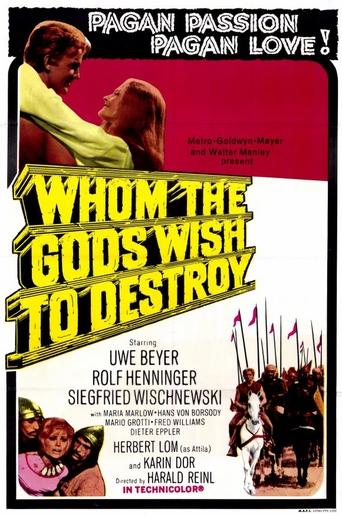
Whom the Gods Wish to Destroy (1966)
Die Nibelungen, Teil 1: Siegfried
Siegfried of Xanten snatches the Nibelung treasure from the king of the underworld and slays the dragon Fafnir, whose blood makes him invulnerable. Siegfried falls in love with Kriemhild, the sister of the Burgundian king. But only if Siegfried helps Gunther marry Brunhild will he be allowed to marry Kriemhild. He fulfills this condition, but the two women bring ruin upon Xanten and Burgundy...
- Date of release
- 1966-12-13
- TMDB
- 6.4 / 10 (20)
- Runtime
- 1h 31m
- Genres
- Drama, Adventure, Fantasy
- Director
- Harald Reinl
- Collection
- The Nibelungen (CCC Remake) Collection
Casting
- Uwe Beyer — Siegfried
- Karin Dor — Brunhild
- Maria Marlow — Kriemhild
- Rolf Henniger — König Gunther
- Siegfried Wischnewski — Hagen
- Hans von Borsody — Volker von Alzey
- Fred Williams — Gernot
- Terence Hill — Giselher
- Dieter Eppler — Rüdiger von Bechlarn
- Skip Martin — Alberich
- Samson Burke — Blo-Edin
- Hilde Weissner — Königin Ute
Interesting facts
Die Nibelungen is a 1966/1967 West German fantasy film released in two parts, Siegfried von Xanten and Kriemhilds Rache. It was directed by Harald Reinl and produced by Artur Brauner. Die Nibelungen starred Uwe Beyer, Karin Dor and Herbert Lom. The two films were a remake of Fritz Lang's 1924 silent classic Die Nibelungen, which was in turn based on the epic poem the Nibelungenlied.
Production
Die Nibelungen is a remake of the eponymous 1924 silent film directed by Fritz Lang. Lang's film had also been released in two parts (Siegfried and Kriemhilds Rache) and was based on a screenplay written by Lang and his wife, Thea von Harbou. The original source for the story was the Middle High German epic poem Das Nibelungenlied, likely written around the year 1200. This in turn was based on motifs from even older Germanic myths.
In the late 1950s, German producer Artur Brauner had wanted Fritz Lang to remake his own silent film and had already informed the press that the project would go ahead. However, in the fall of 1959, Lang energetically resisted this proposal, pointing out that it could be interpreted as Lang "not having anything new to say and being forced to fall back on successes of the past".
The 1966/1967 film was produced by Artur Brauner's CCC Filmkunst in cooperation with Belgrad-based Avala Film. Both parts were shot back-to-back between 20 April and 20 October 1966. Locations included what was then Yugoslavia (today's Serbia: Sremska Rača, Smederevo fortress and Slovenia: Postojna Cave) as well as Iceland, and Spain (Ciudad Encantada and Cuenca).
According to a survey conducted by the Allensbach Institute prior to shooting, 35% of respondents wanted to see a movie about the hero Siegfried, but he had to be blonde and played by an unknown actor. Uwe Beyer, an olympic hammer thrower (bronze medalist in 1964) was selected to play Siegfried. He had no prior acting experience and was dubbed by Thomas Danneberg in postproduction.
Read on Wikipedia · Text from Wikipedia, CC BY-SA 4.0. Data from Wikidata.
Recommended
- Ring of the Nibelungs 2004 · ★ 6.2
- The Lord of the Rings: The Fellowship of the Ring 2001 · ★ 8.5
- The Lord of the Rings: The Two Towers 2002 · ★ 8.4
- The Hobbit: An Unexpected Journey 2012 · ★ 7.4
- The Hobbit 1977 · ★ 6.6
- The Hobbit: The Battle of the Five Armies 2014 · ★ 7.3
- The Hobbit: The Desolation of Smaug 2013 · ★ 7.6
- Warcraft 2016 · ★ 6.4
- The Lord of the Rings: The Return of the King 2003 · ★ 8.5
- Hagen 2024 · ★ 6.2
- Damsel 2024 · ★ 7.0
- Legend 1985 · ★ 6.3