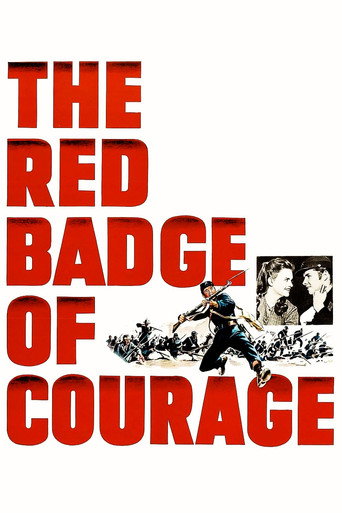
The Red Badge of Courage (1951)
Stephen Crane's Great American Story of the Civil War
Henry Fleming is a young Union soldier in the American Civil War. During his unit's first engagement, Henry flees the battlefield in fear. When he learns that the Union actually won the battle, shame over his cowardice leads him to lie to his friend Tom and the other soldiers, saying that he had been injured in battle. However, when he learns that his unit will be leading a charge against the enemy, Henry takes the opportunity to face his fears and redeem himself.
- Date of release
- 1951-09-27
- TMDB
- 6.4 / 10 (72)
- Runtime
- 1h 9m
- Genres
- War
- Director
- John Huston
Casting
- Audie Murphy — The Youth
- Bill Mauldin — The Loud Soldier
- Douglas Dick — The Lieutenant
- Royal Dano — The Tattered Man
- John Dierkes — Jim Conklin - the Tall Soldier
- Arthur Hunnicutt — Bill Porter
- Tim Durant — The General
- Andy Devine — The Cheery Soldier
- Robert Easton — Thompson
- William Phipps — Officer (uncredited)
- William Schallert — Union Soldier (uncredited)
- John Huston — Grizzled Union Veteran (uncredited)
Interesting facts
- Based on: The Red Badge of Courage
- Awards: 1 · Nominations: 0. Including: National Board of Review: Top Ten Films
The Red Badge of Courage is a 1951 Metro-Goldwyn-Mayer American war film directed by John Huston and produced by Gottfried Reinhardt, with Dore Schary as executive producer. Huston wrote the screenplay, adapted by Albert Band from Stephen Crane's 1895 novel of the same name. The film's cinematographer was Harold Rosson, and the music score was composed by Bronislau Kaper. The production of the film is the subject of Lillian Ross's 1952 book Picture, originally published as a series in The New Yorker.
Production
Director John Huston employed unusual compositions and camera angles drawn from film noir to create an alienating battlefield environment.
Huston considered the original two-hour cut of the film to be the best that he had ever directed. However, following poor audience response to West Coast audience screenings, Metro-Goldwyn-Mayer (MGM) postponed the film's release and cut its length to 70 minutes. Huston and star Murphy unsuccessfully tried to purchase the film so that it could be restored to its original length.
MGM later claimed that the excised footage had been destroyed, probably in the 1965 MGM vault fire. In 1975, MGM asked Huston whether he possessed an original cut, because the studio wanted to re-release it. Huston informed the studio that he did not have the full cut and that it did not exist.
Of the stars who appear in the film, three served in World War II: Bill Mauldin, the editorial cartoonist whose work was compiled in the bestselling book Up Front; Audie Murphy, who served with the U.S. Army in Europe; and narrator James Whitmore, who served in the U.S. Marine Corps.
Much of the history of the production of the film is documented in Lillian Ross' critically acclaimed book Picture.
Read on Wikipedia · Text from Wikipedia, CC BY-SA 4.0. Data from Wikidata.
Recommended
- The One That Got Away 1957 · ★ 6.8
- Gettysburg 1993 · ★ 7.0
- The Birth of a Nation 1915 · ★ 5.9
- What Did You Do in the War, Daddy? 1966 · ★ 5.9
- A Time to Love and a Time to Die 1958 · ★ 7.2
- Taking Sides 2002 · ★ 6.3
- The General 1926 · ★ 7.9
- Cast a Giant Shadow 1966 · ★ 6.3
- Waiting for Anya 2020 · ★ 6.3
- The Guns of Navarone 1961 · ★ 7.3
- Why We Fight: Prelude to War 1942 · ★ 6.5
- Fixed Bayonets! 1951 · ★ 6.5