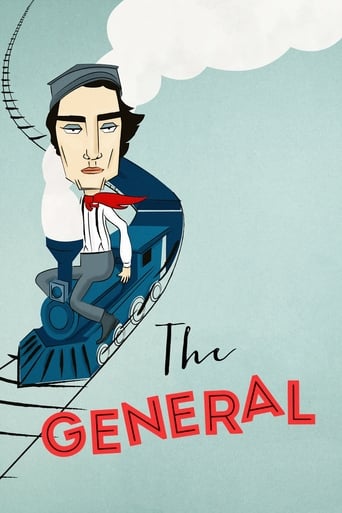
The General (1926)
Buster drives "The General" to trainload of laughter.
During America’s Civil War, Union spies steal engineer Johnnie Gray's beloved locomotive, 'The General'—with Johnnie's lady love aboard an attached boxcar—and he single-handedly must do all in his power to both get The General back and to rescue Annabelle.
- Date of release
- 1926-12-25
- TMDB
- 7.9 / 10 (1501)
- Runtime
- 1h 19m
- Genres
- Comedy, War, Romance
- Director
- Clyde Bruckman, Buster Keaton
Casting
- Buster Keaton — Johnnie Gray
- Marion Mack — Annabelle Lee
- Glen Cavender — Captain Anderson
- Jim Farley — General Thatcher
- Frederick Vroom — A Southern General
- Frank Barnes — Annabelle's Brother
- Charles Henry Smith — Annabelle's Father
- Joe Keaton — Union General
- Mike Donlin — Union General
- Tom Nawn — Union General
- Henry Baird — Soldier (uncredited)
- Joe Bricher — Soldier (uncredited)
Interesting facts
- Budget: $415.2K
- Filmed in: Santa Monica and Cottage Grove
The General is a 1926 American silent comedy film released by United Artists. It was inspired by the Great Locomotive Chase, a true story of an event that occurred during the American Civil War. The story was adapted from the 1889 memoir The Great Locomotive Chase by William Pittenger. The film stars Buster Keaton, who also co-directed it along with Clyde Bruckman.
Production
In early 1926, Keaton's collaborator Clyde Bruckman told him about William Pittenger's 1889 memoir The Great Locomotive Chase about the 1862 Great Locomotive Chase. Keaton was a huge fan of trains and had read the book. Although it was written from the Union Army perspective, Keaton did not believe that the audience would accept Confederates as villains and changed the story's point of view.
In April 1926, Keaton's location manager, Burt Jackson, found an area in Oregon with old-fashioned railroads which he ascertained to be more authentic in terms of period setting for the film. He also discovered that the Oregon, Pacific and Eastern Railway owned two vintage locomotives operating in lumber service that looked the part and purchased them for the production.
The cast and crew arrived in Cottage Grove, Oregon, on May 27, 1926, with 18 freight cars full of Civil War-era cannons, rebuilt passenger cars, stagecoaches, houses, wagons and laborers. The crew stayed at the Bartell Hotel in nearby Eugene, and brought three 35 mm cameras with them from Los Angeles. On May 31, set construction began, and regular train service in Cottage Grove ceased until the end of production.
Filming began on June 8. At first, Keaton completely ignored Mack on set. She said that "Buster just stuck to the job and to his little clique, and that was all" and that the crew "stopped the train when they saw a place to play baseball." Keaton eventually came to like Mack, often playing practical jokes on her.
According to a United Artists press release at the time, the film had 3,000 people on its payroll and cost $400 an hour to make. Entertainment trade papers reported rumors that the film's budget had grown to between $500,000 and $1 million, and that Keaton was out of control, building real bridges and having dams constructed to change the depths of rivers. Producer Schenck was angry at Keaton over the growing costs.
Read on Wikipedia · Text from Wikipedia, CC BY-SA 4.0. Data from Wikidata.
Recommended
- Block-Heads 1938 · ★ 7.0
- Shoulder Arms 1918 · ★ 6.8
- Operation Petticoat 1959 · ★ 7.2
- Silver Streak 1976 · ★ 6.7
- To Be or Not to Be 1942 · ★ 7.8
- Carry On Sergeant 1958 · ★ 6.4
- Goin' South 1978 · ★ 5.8
- Our Hospitality 1923 · ★ 7.5
- What Did You Do in the War, Daddy? 1966 · ★ 5.9
- To Be or Not to Be 1983 · ★ 6.7
- Oh! What a Lovely War 1969 · ★ 6.7
- The Pride and the Passion 1957 · ★ 6.0