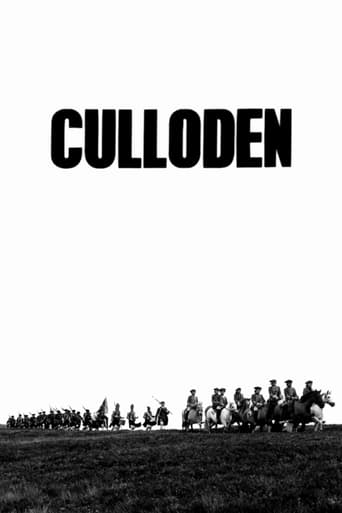
Culloden (1964)
Culloden, Scottish Highlands, April 16th, 1746. It was one of the most mishandled and brutal battles ever fought in Great Britain. Its aftermath was tragic. The men responsible for such a disaster must be exposed. The men, women and children who suffered because of it must be remembered.
- Date of release
- 1964-12-15
- TMDB
- 7.4 / 10 (58)
- Runtime
- 1h 9m
- Genres
- TV Movie, War, History, Drama
- Director
- Peter Watkins
Casting
- George McBean — Alexander McDonald (uncredited)
- Olivier Espitalier-Noel — Prince Charles Edward Stuart (uncredited)
- Tony Cosgrove — Lt. Ward / Field Interviewer (voice) (uncredited)
- Robert Oates — Private Alexander Laing (uncredited)
- Patrick Watkins — Crying Baby (uncredited)
- Don Fairservice — English Officer (uncredited)
- Peter Watkins — Field Interviewer (voice) (uncredited)
Interesting facts
Culloden is a 1964 docudrama written and directed by Peter Watkins for BBC TV. It depicts the 1746 Battle of Culloden, the final engagement of the Jacobite rising of 1745 which saw the Jacobite Army be decisively defeated by government troops and, in the words of the narrator, "tore apart forever the clan system of the Scottish Highlands."
Production
In late 1962 Watkins was engaged as an assistant producer for the BBC's newly established Channel 2, and was later approached by head of the documentary film department Huw Wheldon, to produce a film on the Battle of Culloden.
Culloden was to be Watkins's first full-length film. It was also his first use of his docudrama style in which actors portray historical characters being interviewed by filmmakers on the scene as though it were happening in front of news cameras. The film was produced on a low budget, with only a handful of extras and a single cannon. Watkins made use of carefully planned camera angles to give the appearance of an army.
Watkins also "wanted to break through the conventional use of professional actors in historical melodramas, with the comfortable avoidance of reality that these provide, and to use amateurs—ordinary people—in a reconstruction of their own history." He accordingly used an all-amateur cast from London and the Scottish Lowlands for the Hanoverian forces, and people from Inverness for the Jacobite army, many of whom were direct descendants of those w…
Filming took place in August 1964, near Inverness. According to an estimate by the cinematographer for the film, Dick Bush, about 85% of all camerawork in Culloden was hand-held. This cinéma vérité-style shooting gave an already gritty reality a sense of present action.
Read on Wikipedia · Text from Wikipedia, CC BY-SA 4.0. Data from Wikidata.
Recommended
- Rob Roy 1995 · ★ 6.7
- The Scarlet and the Black 1983 · ★ 7.1
- The Charge of the Light Brigade 1968 · ★ 6.2
- Gettysburg 1993 · ★ 7.0
- The Alamo 1960 · ★ 7.1
- Gods and Generals 2003 · ★ 6.4
- Uprising 2001 · ★ 6.6
- Henry V 1944 · ★ 6.7
- Devotion 2022 · ★ 7.0
- Peterloo 2018 · ★ 6.7
- Bury My Heart at Wounded Knee 2007 · ★ 6.5
- King Arthur 2004 · ★ 6.3