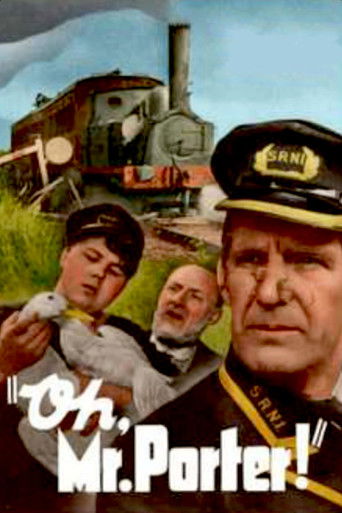
Oh, Mr. Porter! (1937)
Comedy in which a bungling railway worker is given the job of stationmaster at a rundown station in rural Ireland, where his sidekicks are a toothless old gaffer and a portly young loudmouth. Hilarious adventures ensue, including a locomotive chase after gunrunners make off with a train.
- Date of release
- 1937-10-05
- TMDB
- 7.0 / 10 (34)
- Runtime
- 1h 25m
- Genres
- Comedy
- Director
- Marcel Varnel
Casting
- Will Hay — William Porter
- Moore Marriott — Jeremiah Harbottle
- Graham Moffatt — Albert Brown
- Percy Walsh — Superintendent
- Dave O'Toole — Postman
- Sebastian Smith — Mr. Trimbletow
- Agnes Lauchlan — Mrs. Trimbletow
- Dennis Wyndham — Grogan/One Eyed Joe
- Frederick Piper — Mr. Leadbetter - Railway Official (uncredited)
- Frederick Lloyd — Official at Ceremony
- Beatrice Varley — Barney's Bar Landlady
- Frank Atkinson — Irate Irishman in Barney's Bar
Interesting facts
Oh, Mr Porter! is a 1937 British comedy film starring Will Hay with Moore Marriott and Graham Moffatt and directed by Marcel Varnel. While not Hay's commercially most successful, it is his best-known film to modern audiences. It is widely acclaimed as the best of Hay's work, and a classic of its genre. The film had its first public showing in November 1937 and went on general release on 3 January 1938. The plot of Oh, Mr Porter was loosely based on the Arnold Ridley play The Ghost Train. The title was taken from Oh! Mr Porter, a music hall song.
Production
The movie was one of several comedies Hay made at Gainsborough under Ted Black.
Despite the majority of the film being set in Northern Ireland, none of the filming took place there; the railway station at Buggleskelly was the disused Cliddesden railway station on the Basingstoke and Alton Light Railway, which had closed to goods in 1936. Oh, Mr Porter! was filmed at Cliddesden between May and July 1937. All the interior shots were made at Gainsborough Studios, Shepherds Bush, during the August.
The title sequence uses scenes shot at a variety of locations on the Waterloo to Southampton railway line and also between Maze Hill and Greenwich in south-east London. The scene in which Porter travels to Buggleskelly by bus, while being warned of a terrible danger by locals, parodies that of the Tod Browning film, Dracula (1931).
The Southern Railway of Northern Ireland that Porter works for is fictitious. In reality, from the route chosen on the map, the line would have belonged to the Great Northern Railway (Ireland), with Buggleskelly being close to the real town of Lisnaskea.
Read on Wikipedia · Text from Wikipedia, CC BY-SA 4.0. Data from Wikidata.
Recommended
- The Titfield Thunderbolt 1953 · ★ 7.0
- Scooby-Doo! and the Loch Ness Monster 2004 · ★ 7.3
- Pete's Dragon 1977 · ★ 6.3
- Klaus 2019 · ★ 8.2
- Shaun the Sheep Movie 2015 · ★ 7.0
- That Christmas 2024 · ★ 7.1
- An American Tail: Fievel Goes West 1991 · ★ 6.3
- Riverdance: The Animated Adventure 2021 · ★ 6.0
- The Hallelujah Trail 1965 · ★ 6.1
- Way Out West 1937 · ★ 7.1
- A Minecraft Movie 2025 · ★ 6.2
- Nanny McPhee 2005 · ★ 6.7