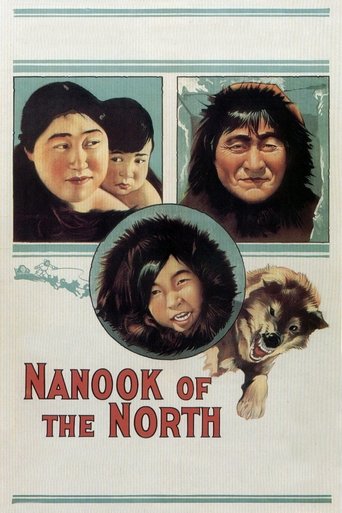
Nanook of the North (1922)
A story of life and love in the actual Arctic.
This pioneering documentary film depicts the lives of the indigenous Inuit people of Canada's northern Quebec region. Although the production contains some fictional elements, it vividly shows how its resourceful subjects survive in such a harsh climate, revealing how they construct their igloo homes and find food by hunting and fishing. The film also captures the beautiful, if unforgiving, frozen landscape of the Great White North, far removed from conventional civilization.
- Date of release
- 1922-06-11
- TMDB
- 7.1 / 10 (339)
- Runtime
- 1h 19m
- Genres
- Documentary, Drama
- Director
- Robert Flaherty
Casting
- Allakariallak — Nanook
- Alice Nevalinga — Nanook's Wife - the Smiling One
- Cunayou — Cunayou - Nanook's Daughter
- Allegoo — Allegoo - Nanook's Son
- Allee — Allee - Nanook's Son
Interesting facts
Nanook of the North is a 1922 American silent film that combines elements of documentary and docudrama/docufiction, at a time when the concept of separating films into documentary and drama did not yet exist. In the tradition of what would later be called salvage ethnography, the film follows the struggles of the Inuk man named Nanook and his family in the Canadian Arctic. It is written and directed by Robert J. Flaherty, who also served as cinematographer, editor, and producer.
Production
In 1910, Flaherty was hired by Sir William Mackenzie as an explorer and prospector searching for iron ore and other mineral deposits along the Hudson Bay for the Canadian Northern Railway. Learning about the lands and people there, Flaherty decided on his third expedition in 1913 to bring with him a glass-plate still camera and movie camera as well as a small portable printer and processor.
Using a Bell & Howell camera, a portable developing and printing machine, and some lighting equipment, Flaherty spent 1914 and 1915 shooting hours of film of Inuit life. By 1916, Flaherty had enough footage to begin evaluating screenings and was met with wide enthusiasm. However, in 1916, Flaherty dropped a cigarette onto the original camera negative (which was highly flammable nitrate stock) and lost 30,000 feet of film.
The building of the igloo is one of the most celebrated sequences in the film, but interior photography presented a problem. Building an igloo large enough for a camera to enter resulted in the dome collapsing, and when they finally succeeded in making the igloo it was too dark for photography.
Read on Wikipedia · Text from Wikipedia, CC BY-SA 4.0. Data from Wikidata.
Recommended
- Dawson City: Frozen Time 2017 · ★ 6.8
- Earth 2007 · ★ 7.7
- Alone in the Wilderness 2004 · ★ 7.9
- All That Breathes 2022 · ★ 6.9
- The Class of ‘92 2013 · ★ 7.1
- Polar Bear 2022 · ★ 7.2
- Powaqqatsi 1988 · ★ 7.2
- Western Stars 2019 · ★ 7.0
- The Show Must Go On: The Queen + Adam Lambert Story 2019 · ★ 7.3
- Born to Be Wild 2011 · ★ 7.0
- 14 Peaks: Nothing Is Impossible 2021 · ★ 7.3
- Stories We Tell 2012 · ★ 7.1