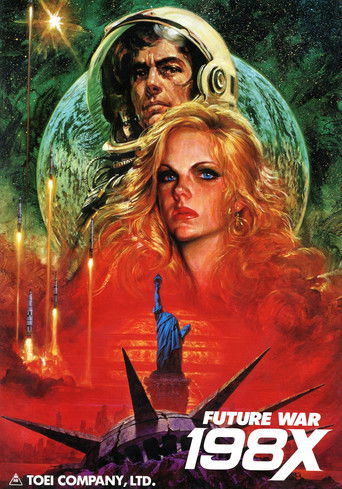
Future War 198X (1982)
FUTURE WAR 198X年
Now … Never say Never.
An American scientist constructs a laser satellite with hopes of preventing any nuclear conflicts from occurring. However, after a fatal error from both the US and the USSR governments, war breaks out and humanity faces a new bloodshed.
- Date of release
- 1982-10-30
- TMDB
- 5.9 / 10 (12)
- Runtime
- 2h 5m
- Genres
- Drama, War, Action, Science Fiction, Animation
- Director
- Tomoharu Katsumata, Toshio Masuda
Casting
- Masashi Amenomori — General Secretary Orlov (voice)
- Yoshio Kaneuchi — President Gibson (voice)
- Kinya Kitaoji — Wataru Mikumo (voice)
- Masako Natsume — Laura Gaine (voice)
- Hidekatsu Shibata — Burt Gaine (voice)
- Osamu Kobayashi — Secretary of State Girard (voice)
- Takeshi Aono — Minister of Defence Bugarrin (voice)
- Tamio Ohki — Joint Chief of Staff McCoy (voice)
- Youichi Miyagawa — Vice Premier Kutuzov (voice)
- Ai Sakuma — Lena (voice)
- Chikao Ohtsuka — Commander Stroganov (voice)
- Gorō Naya — DF Commander Tono (voice)
Interesting facts
Future War 198X is a 1982 Japanese anime science fiction war original video animation directed by Toshio Masuda and Tomoharu Katsumata. Set during the Cold War in an unspecified year of the 1980s, the film details the outbreak of World War III between NATO and the Warsaw Pact. It is partially inspired by the 1982 speculative war novel The Third World War: The Untold Story by Sir John Hackett.
Production
It is unclear when production on Future War 198X started, but it was primarily conducted by Toei Animation. Most of the production staff had previously worked on the Space Battleship Yamato franchise. Toei Animation's managing director Akinori Watanabe stated Toei's intention was to produce the film in a "realistic" art style with "Western-style images"; to this end, the film's aesthetic was mostly influenced by Japanese film illustrator Noriyosh…
Production was assisted by former Japan Self-Defense Forces Major General Iwano Masataka, the film's music was performed by the New Japan Philharmonic, and the film's costumes were designed by French fashion designer André Courrèges. Production cost a total of approximately 600 million yen.
In February 1981, Toei Animation's labor union received an early copy of the film's script and, after reviewing it, described it as "dangerous", citing a pro-war narrative that viewed nuclear warfare positively. In April 1981, the union announced in The Asahi Shimbun that their members would not be participating in the film's production. This forced the film's animation to be completed by outsourced animators.
Future War 198X was controversial in Japan due to its depictions of nuclear war and the aftermath of war, and it was argued that the film glorified warfare, was right-wing propaganda, or was otherwise unsuitable for children to watch.
The April 1982 issue of Animage covered the controversy in an article by Koichi Kato, in which several Future War 198X staff members, including Toei managing director Akinori Watanabe, provided details on the film's development and responded to criticisms, interspersed with commentary from parent–teacher association members and labor union officials.
Read on Wikipedia · Text from Wikipedia, CC BY-SA 4.0. Data from Wikidata.
Recommended
- Legend of the Galactic Heroes: My Conquest Is the Sea of Stars 1988 · ★ 7.9
- Legend of the Galactic Heroes: Overture to a New War 1993 · ★ 8.2
- BLAME! 2017 · ★ 6.5
- Doraemon: Nobita's Little Star Wars 1985 · ★ 7.2
- Seal Team Eight: Behind Enemy Lines 2014 · ★ 6.1
- Genocidal Organ 2017 · ★ 6.7
- The Kill Team 2019 · ★ 6.5
- Code Geass: Akito the Exiled 5: To Beloved Ones 2016 · ★ 6.2
- Battleground 1949 · ★ 6.7
- Doraemon: Nobita and the Winged Braves 2001 · ★ 7.1
- Black Magic M-66 1987 · ★ 6.3
- Code Geass: Akito the Exiled 1: The Wyvern Arrives 2012 · ★ 6.2