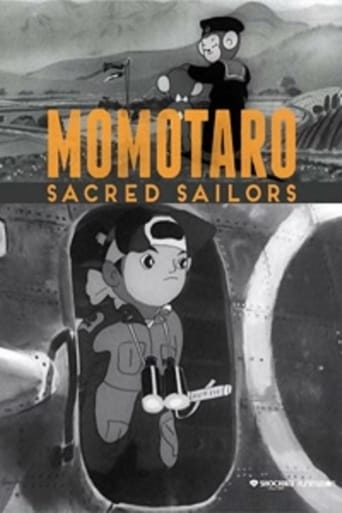
Momotaro, Sacred Sailors (1945)
桃太郎 海の神兵
The first Japanese feature-length animated film. It was directed by Mitsuyo Seo, who was ordered to make a propaganda film for the war by the Japanese Naval Ministry. Shochiku Moving Picture Laboratory shot the 74-minute film in 1944 and screened it on April 12, 1945. It is a sequel to Momotarō no Umiwashi, a 37-minute film released in 1943 by the same director. It is black and white. The whole movie also depicts the Japanese "liberation of Asia", as proclaimed by the Government at the time. Seo tried to give dreams to children, as well as to instill the hope for peace, with hidden movie's hints of dreams and hopes, under the appearance of war propaganda.
- Date of release
- 1945-03-12
- TMDB
- 4.7 / 10 (19)
- Runtime
- 1h 14m
- Genres
- Animation, Action
- Director
- Mitsuyo Seo
Interesting facts
Momotaro: Sacred Sailors is the first Japanese feature-length animated film. It was directed by Mitsuyo Seo, who was ordered to make a propaganda film for World War II by the Japanese Naval Ministry. Shochiku Moving Picture Laboratory shot the 74-minute film in 1944 and screened it on 12 April 1945. It is a sequel to Momotarō no Umiwashi, a 37-minute film released in 1943 by the same director and also starring the traditional Momotarō character.
Background
The Naval Ministry previously showed Seo Fantasia (1940), the Disney film. Inspired by this, Seo tried to give dreams to children, as well as to instill the hope for peace, just as he did in the film's predecessor, Momotaro's Sea Eagles. At that time, unlike German animation and American animation, Japanese animation was not fully promoted as a tool for propaganda by the Japanese government.
For a long time, the film was presumed to have been confiscated and burned by the American occupation. However, a negative copy of the film was found in Shochiku's Ofuna warehouse in 1983 and was re-released in 1984. A reproduced film was later screened and the VHS package is now available in Japan.
Read on Wikipedia · Text from Wikipedia, CC BY-SA 4.0. Data from Wikidata.
Recommended
- X 1996 · ★ 6.2
- One Piece Episode of Sabo: The Three Brothers' Bond - The Miraculous Reunion and the Inherited Will 2015 · ★ 7.0
- Grappler Baki: The Ultimate Fighter 1994 · ★ 6.7
- Black Magic M-66 1987 · ★ 6.3
- Walking with the Enemy 2014 · ★ 6.3
- A Thousand and One Nights 1969 · ★ 6.6
- The Testament of Sister New Devil: Departures 2018 · ★ 7.5
- America: The Motion Picture 2021 · ★ 5.9
- Demon City Shinjuku 1988 · ★ 6.0
- Inuyasha the Movie 2: The Castle Beyond the Looking Glass 2002 · ★ 7.7
- Tales of the Black Freighter 2009 · ★ 6.6
- The Witcher: Sirens of the Deep 2025 · ★ 6.7