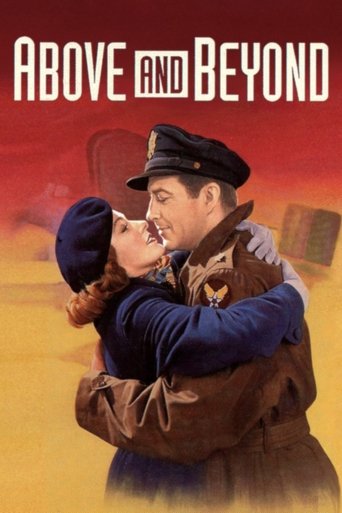
Above and Beyond (1953)
The love story behind the billion dollar secret!
The story of Colonel Paul Tibbets, the pilot that dropped the atomic bomb on Hiroshima. Although unaware of the full potential of this new weapon, he knows that it can do tremendously more damage than any other weapon used before, and that the death toll resulting from it will be huge. He is reluctant to be the person who will end so many lives, but as time goes on, the pressure upon him only increase.
- Date of release
- 1953-01-02
- TMDB
- 6.2 / 10 (18)
- Runtime
- 2h 2m
- Genres
- Action, Drama, War
- Director
- Melvin Frank, Norman Panama
Casting
- Robert Taylor — Lt. Col Paul W. Tibbets
- Eleanor Parker — Lucey Tibbets
- James Whitmore — Maj. William M. Uanna
- Larry Keating — Maj. Gen. Vernon C. Brent
- Larry Gates — Capt. William Parsons
- Marilyn Erskine — Marge Bratton
- Stephen Dunne — Maj. Harry Bratton
- Robert Burton — Gen. Samuel E. Roberts
- Hayden Rorke — Dr. Ramsey
- Lawrence Dobkin — Dr. Van Dyke
- Jack Raine — Dr. Fiske
- Jonathan Cott — Capt. Dutch van Kirk
Interesting facts
- Awards: 1 · Nominations: 2. Including: National Board of Review: Top Ten Films
Above and Beyond is a 1952 American World War II docudrama film directed by Melvin Frank and Norman Panama about Lt. Col. Paul W. Tibbets Jr., the pilot of the aircraft that dropped the atomic bomb on Hiroshima in August 1945. The film stars Robert Taylor as Tibbets and features a love story with Eleanor Parker as his wife.
Production
The film was suggested by screenwriter Beirne Lay Jr., a colonel in the Air Force Reserve, to General Curtis LeMay, commander of the Strategic Air Command (SAC). The men had previously discussed the high rate of divorce among flight crews and felt that a film depicting the problem might help raise morale.
Lay suggested a film based on the experiences of Colonel Paul Tibbets, commander of the 509th Composite Group during World War II. LeMay approved, and after writing an outline, Lay transferred scriptwriting duties to Melvin Frank and Norman Panama. Although Tibbets lent his full approval and support to the film, he felt that he was too closely involved to be objective and suggested Lt. Col. Charles F.H.
The film was originally titled Eagle on His Cap. Studio principal photography began on February 5, 1952 before transferring to Davis–Monthan Air Force Base, which was predominantly utilized for the airfield scenes at Wendover Air Force Base, Boeing's Wichita testing area and Tinian. The production wrapped on March 26, 1952.
For dramatic effect, some incidents were somewhat exaggerated, such as the scene in which the Hiroshima bomb is armed mid-flight. The filmmakers added some turbulence to increase tension, although the actual flight was perfectly smooth throughout. In addition, the entire mission is depicted in daylight, although the actual takeoff from Tinian was in full darkness at 2:45 a.m.
Coproducer Norman Panama claimed that the system that he and Melvin Frank implemented for The Reformer and the Redhead (1950) by which all shots and dialogue were precisely planned and diagrammed, with suggestions welcomed from the cast and crew, saved $76,000 per day of production.
Read on Wikipedia · Text from Wikipedia, CC BY-SA 4.0. Data from Wikidata.
Recommended
- Battleground 1949 · ★ 6.7
- Blood on the Sun 1945 · ★ 5.9
- One of Our Aircraft Is Missing 1942 · ★ 6.6
- The Bridge at Remagen 1969 · ★ 6.8
- Waiting for Anya 2020 · ★ 6.3
- The Bridge on the River Kwai 1957 · ★ 7.8
- The One That Got Away 1957 · ★ 6.8
- The Devil's Brigade 1968 · ★ 6.3
- The Guns of Navarone 1961 · ★ 7.3
- Empire of the Sun 1987 · ★ 7.5
- The Last Rifleman 2023 · ★ 6.6
- Taking Sides 2002 · ★ 6.3