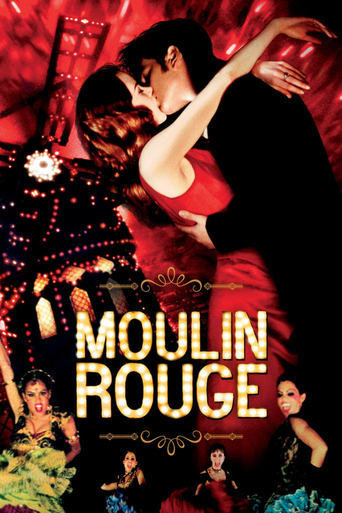
Moulin Rouge! (2001)
The greatest thing you'll ever learn is just to love.... and be loved in return.
A celebration of love and creative inspiration takes place in the infamous, gaudy and glamorous Parisian nightclub, at the cusp of the 20th century. A young poet, who is plunged into the heady world of Moulin Rouge, begins a passionate affair with the club's most notorious and beautiful star.
- Date of release
- 2001-05-18
- TMDB
- 7.5 / 10 (5010)
- Runtime
- 2h 8m
- Genres
- Drama, Romance, Music
- Director
- Baz Luhrmann
Casting
- Ewan McGregor — Christian
- Nicole Kidman — Satine
- John Leguizamo — Toulouse-Lautrec
- Jim Broadbent — Harold Zidler
- Richard Roxburgh — The Duke
- Garry McDonald — The Doctor
- Jacek Koman — The Unconscious Argentinean
- Matthew Whittet — Satie
- Kerry Walker — Marie
- Caroline O'Connor — Nini Legs in the Air
- Christine Anu — Arabia
- Natalie Mendoza — China Doll
Interesting facts
- Box office: $179.2M
- Budget: $50M
- Earned 3.6× its budget
- Filmed in: Madrid and Sydney
- Awards: 11 · Nominations: 19. Including: Academy Award for Best Costume Design; Academy Award for Best Production Design; Golden Globe Award for Best Original Score; European Film Award for Best Non-European Film
Moulin Rouge! is a 2001 jukebox musical romantic drama film directed, produced and co-written by Baz Luhrmann. It follows a British poet, Christian, who falls in love with the star of the Moulin Rouge, cabaret actress and courtesan Satine.
Production
Moulin Rouge! was influenced by an eclectic variety of comic and melodramatic musical sources, including the Hollywood musical, "vaudeville, cabaret culture, stage musicals, and operas." Its musical elements also allude to Luhrmann's earlier film Strictly Ballroom.
Giacomo Puccini's opera La bohème, which Luhrmann directed at the Sydney Opera House in 1993, was a key source of the plot for Moulin Rouge!. Further stylistic inspiration came from Luhrmann's encounter with Bollywood films during his visit to India while conducting research for his 1993 production of Benjamin Britten's opera A Midsummer Night's Dream. According to Luhrmann:
. . . we went to this huge, ice cream picture palace to see a Bollywood movie. Here we were, with 2,000 Indians watching a film in Hindi, and there was the lowest possible comedy and then incredible drama and tragedy and then break out in songs. And it was three-and-a-half hours! We thought we had suddenly learnt Hindi, because we understood everything! We thought it was incredible. How involved the audience were.
In the DVD's audio commentary, Luhrmann revealed that he also drew from the Greek tragedy of Orpheus and Eurydice. The filmmakers projected the Orpheus figure onto Christian by characterizing the latter as a musical genius whose talent surpassed that of everyone else in his world. The film's use of songs from the mid- to late 20th century in the 1899 setting makes Christian appear ahead of his time as a musician and writer.
Commentators have also noted the similarities between the film's plot and those of the opera La Traviata and Émile Zola's novel Nana. Other cinematic elements appear to have been borrowed from the musical films Cabaret, Folies Bergère de Paris, and Meet Me in St. Louis.
Read on Wikipedia · Text from Wikipedia, CC BY-SA 4.0. Data from Wikidata.
Recommended
- Before Sunset 2004 · ★ 7.8
- Cyrano 2021 · ★ 6.3
- Cyrano de Bergerac 1950 · ★ 6.9
- Once 2007 · ★ 7.4
- Staying Alive 1983 · ★ 5.8
- The Lost Husband 2020 · ★ 6.6
- The Story of Vernon and Irene Castle 1939 · ★ 7.0
- Maria 2024 · ★ 6.5
- Five Feet Apart 2019 · ★ 8.2
- Love and Death on Long Island 1998 · ★ 6.3
- Purple Hearts 2022 · ★ 8.0
- Me Before You 2016 · ★ 7.9