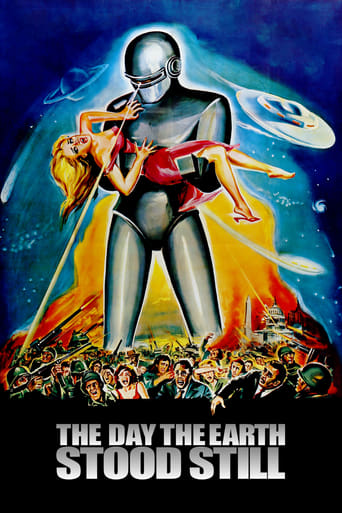
The Day the Earth Stood Still (1951)
From out of space...A warning and an ultimatum.
An alien and a robot land on Earth after World War II and tell mankind to be peaceful or face destruction.
- Date of release
- 1951-09-18
- TMDB
- 7.4 / 10 (1320)
- Runtime
- 1h 32m
- Genres
- Science Fiction, Thriller, Drama
- Director
- Robert Wise
Casting
- Michael Rennie — Klaatu / Mr. Carpenter
- Patricia Neal — Helen Benson
- Billy Gray — Bobby Benson
- Sam Jaffe — Prof. Jacob Barnhardt
- Hugh Marlowe — Tom Stevens
- Lock Martin — Gort
- Freeman Lusk — General Cutler
- Edith Evanson — Mrs. Crockett (uncredited)
- Frank Conroy — Mr. Harley
- Frances Bavier — Mrs. Barley
- John Brown — George Barley
- Olan Soule — Mr. Krull
Interesting facts
- Budget: $995K
- Based on: Farewell to the Master
- Awards: 1 · Nominations: 0. Including: Golden Globe Award for Best Film Promoting International Understanding
The Day the Earth Stood Still is a 1951 American science fiction film from 20th Century-Fox, produced by Julian Blaustein and directed by Robert Wise. It stars Michael Rennie, Patricia Neal, Hugh Marlowe, Sam Jaffe, Billy Gray, Frances Bavier and Lock Martin. The screenplay was written by Edmund H. North, based on the 1940 science fiction short story "Farewell to the Master" by Harry Bates. The film score was composed by Bernard Herrmann. Set in the Cold War during the early stages of the nuclear arms race, the storyline involves a humanoid alien visitor who comes to Earth, accompanied by a powerful robot, to deliver an important message that will affect the entire human race.
Production
Producer Julian Blaustein originally set out to make a film under the working titles of Farewell to the Master and Journey to the World which illustrated the fear and suspicion that characterized the early Cold War and Atomic Age. He reviewed more than two hundred science fiction short stories and novels in search of a storyline that could be used because this film genre was well suited for a metaphorical discussion of such grave issues.
The set was designed by Thomas Little and Claude Carpenter. They collaborated with the architect Frank Lloyd Wright for the design of the spacecraft. Paul Laffoley has suggested that the futuristic interior was inspired by Wright's Johnson Wax Headquarters, completed in 1936. Laffoley quotes Wright and his attempt in designing the exterior: "... to imitate an experimental substance that I have heard about which acts like living tissue.
Samuel Herrick, an astrophysicist at UCLA, developed the equations on Prof. Barnhardt's blackboard. "Herrick reasoned that an equation related to celestial mechanics would be most appropriate, specifically an equation related to his own work on the "three-body problem" in astronavigation."
Principal outdoor photography was shot on the 20th Century Fox sound stages and on its studio back lot (now located in Century City, California), with a second unit shooting background and other scenes in Washington, D.C., and at Fort George G. Meade in Maryland. The shooting schedule was from April 9 to May 23, 1951, and the primary actors never traveled to Washington to make the film.
The robot Gort was played by Lock Martin, who worked as an usher at Grauman's Chinese Theatre and stood seven feet and seven inches tall. Not accustomed to a confining, heat-inducing costume, he worked carefully while wearing the two oversized, laced up, foamed neoprene suits for the illusion of a seamless metallic Gort.
Read on Wikipedia · Text from Wikipedia, CC BY-SA 4.0. Data from Wikidata.
Recommended
- Star Trek: Insurrection 1998 · ★ 6.5
- Stowaway 2021 · ★ 6.0
- Finch 2021 · ★ 7.8
- The Arrival 1996 · ★ 6.0
- Automata 2014 · ★ 5.9
- I Am Mother 2019 · ★ 6.7
- Terminator Genisys 2015 · ★ 6.0
- Moon 2009 · ★ 7.6
- Close Encounters of the Third Kind 1977 · ★ 7.4
- Silent Running 1972 · ★ 6.4
- Stargate SG-1: Children of the Gods 2009 · ★ 7.2
- Arrival 2016 · ★ 7.6