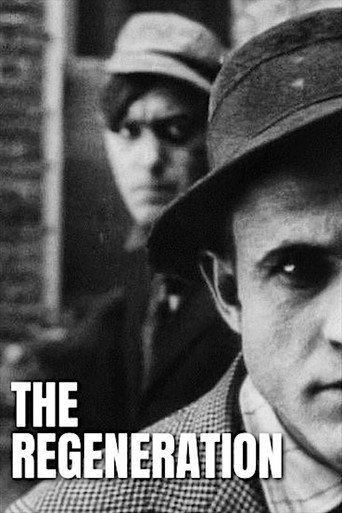
The Regeneration (1915)
At 10 years old, Owen becomes a ragged orphan when his mother dies. Abusive next-door neighbors the Conways take him in, and by 17, Owen has learned that might is right. At 25, he's a career gangster: loitering, gambling and drinking in dens of iniquity. Marie Deering arrives in Owen's area, eager to empower the impoverished, gang-affiliated youth through education. Owen slowly but surely leaves his old life behind, choosing the narrow path- all the while falling in love with Marie. Skinny, who's taken over Owen's role in the gang, reappears to him, spelling trouble.
- Date of release
- 1915-09-13
- TMDB
- 6.8 / 10 (43)
- Runtime
- 1h 12m
- Genres
- Romance, Crime, Drama
- Director
- Raoul Walsh
Casting
- Rockliffe Fellowes — Owen [at 25] Conway
- Anna Q. Nilsson — Marie Deering
- William Sheer — Skinny
- Carl Harbaugh — Ames, District Attorney
- James A. Marcus — Jim Conway
- John McCann — Owen [age 10]
- Harry McCoy — Owen at 17 (as H. McCoy)
- Peggy Barn
- Maggie Weston — Maggie Conway
Interesting facts
- Filmed in: New York City
Regeneration is a 1915 American silent biographical crime drama co-written and directed by Raoul Walsh. The film, which was the first full-length feature film directed by Walsh, stars Rockliffe Fellowes and Anna Q. Nilsson and was adapted for the screen by Carl Harbaugh and Walsh from the 1903 memoir My Mamie Rose, by Owen Frawley Kildare and the adapted 1908 play by Kildare and Walter Hackett.
Production
Set in New York City, Regeneration was shot on location in New York City's Lower East Side and used real prostitutes, gangsters, and homeless people as extras. It is the first produced by Fox Film Corporation, a forerunner of the 20th Century Fox.
By 1915, 28-year-old director Raoul Walsh was in New York, with a three-picture contract with Fox Film Corporation for $400 a week—he was assigned Regeneration, to be the first feature-length gangster film in the United States. It was based on the book My Mamie Rose. Walsh's statement that he wrote the script was contradicted by other comments he made that he worked on it with Carl Harbaugh.
When he filmed the scene with actors jumping off a boat into the river, fireboats and police showed up to calm the "crowds", and Walsh was taken to the local station house, amused. The studio "relished" the free publicity. French cinematographer Georges Benoit worked on the film as his first Fox picture.
Read on Wikipedia · Text from Wikipedia, CC BY-SA 4.0. Data from Wikidata.
Recommended
- The Secret: Dare to Dream 2020 · ★ 7.4
- Fallen Angel 1945 · ★ 6.6
- Peter Ibbetson 1935 · ★ 7.0
- The Lost Husband 2020 · ★ 6.7
- They Live by Night 1949 · ★ 6.8
- Plunder Road 1957 · ★ 6.9
- Lovely, Still 2009 · ★ 6.6
- The History of Love 2016 · ★ 6.4
- Sahara 1983 · ★ 5.9
- The Wild One 1953 · ★ 6.5
- Departure 2016 · ★ 6.3
- The Magic of Ordinary Days 2005 · ★ 7.5