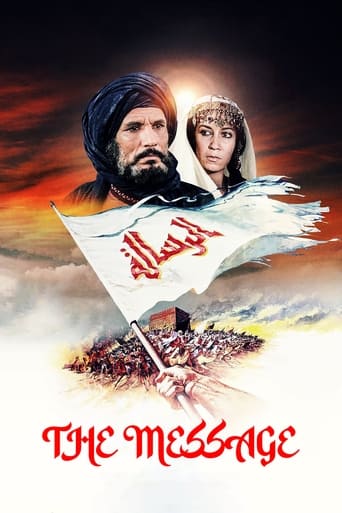
The Message (1976)
Al-risâlah
In sixth-century Mecca, Prophet Muhammad receives his first revelation from God as a messenger. Three years later, he's not alone in his quest and publicly declares his prophecy. Muhammad is fought by Abu Sufian and his wife Hind, rulers of Mecca. Muhammad's followers are hunted and tortured but he continues his calling.
- Date of release
- 1976-07-30
- TMDB
- 8.5 / 10 (53)
- Runtime
- 3h 26m
- Genres
- History, Drama, Adventure
- Director
- Moustapha Akkad
Casting
- Abdallah Ghaith — Hamza ibn al-Muttalib
- Ali Ahmed Salem — Bilal ibn Rabah
- Muhammad al-Arabi — Ammar ibn Yasir
- Mounir Moasery — Djafar ibn Abi Talib
- Ahmed Marei — Zayd ibn Harithah
- Habib Ageli — Houdhayfa ibn Utba
- Hamdy Ghaith — Abou Sufyan ibn Harb
- Mona Wassef — Hind bint Utba
- Hassan al-Jundi — Abou al-Hakam
- Abd al-Badi Arabi — Utba
- Tayeb Saddiki — Al-Walid ibn Utba
- Mahmoud Saeed — Khalid ibn al-Walid
Interesting facts
The Message originally known as Mohammed, Messenger of God is a 1976 epic film directed and produced by Moustapha Akkad that chronicles the life and times of Muhammad, who is never directly depicted.
Production
Moustapha Akkad considered creating a film about Muhammad and the birth of Islam in 1967. The film's script, written by H.A.L. Craig, was approved in its entirety by Tawfiq al-Hakim, a scholar at Al-Azhar University. However, the film's approval was revoked and referred to as "an insult to Islam".
$10 million was raised for the film from Kuwait, Libya, Morocco, Saudi Arabia and the United States and it had a final budget of $17 million. Akkad started filming in 1974, with a crew of 300, 40 actors for both English and Arabic language versions, and over 5,000 people for crowd shots. A $700,000 replica of Mecca was built near Marrakesh and Anthony Quinn was paid $1.5 million according to Michael Ansara.
Filming in Morocco started in April 1974, but Moroccan police forced them to stop filming on 5 August, as Hassan II of Morocco had been pressured by Faisal of Saudi Arabia. Akkad was granted permission to film in Libya after showing unedited film to Muammar Gaddafi and filmed from October 1974 to May 1975. Gaddafi wanted Akkad to also make a film based on the life of Omar al-Mukhtar.
A light bulb on the camera was used during the scenes of characters with Muhammad to represent his immanence. Islamic scholar Khaled Abou El Fadl, who was a friend of Akkad, praised his depiction of Muhammad stating that "To figure out a way to have the prophet become a person without showing him — it was brilliant".
Akkad saw the film as a way to bridge the gap between the Western and Islamic worlds, stating in a 1976 interview:
Read on Wikipedia · Text from Wikipedia, CC BY-SA 4.0. Data from Wikidata.
Recommended
- The Message 1976 · ★ 7.1
- The Call of the Wild 1972 · ★ 6.1
- Miss Fisher and the Crypt of Tears 2020 · ★ 6.1
- The Wind and the Lion 1975 · ★ 6.5
- The Sea Wolf 1941 · ★ 7.2
- Benji 2018 · ★ 6.9
- I Am David 2003 · ★ 6.8
- Theeb 2014 · ★ 6.7
- The Wolf and the Lion 2021 · ★ 7.5
- Mio in the Land of Faraway 1987 · ★ 6.0
- The Black Pirate 1926 · ★ 6.7
- Ben-Hur 1959 · ★ 7.9