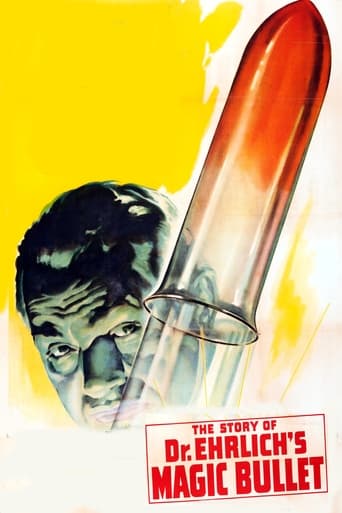
Dr. Ehrlich's Magic Bullet (1940)
NOT A GANGSTER PICTURE BUT ...a war on the deadliest public enemy of all!
German scientist Paul Ehrlich makes remarkable advancements in the field of medical diagnostics with his research in cellular staining with dyes. His work results in new knowledge about tuberculosis, but also leads to his contraction of the disease. Ehrlich travels to Egypt, where he investigates diphtheria and earns more accolades. Eventually, his research in treating diseases leads to the development of a 'magic bullet' treatment for syphilis.
- Date of release
- 1940-02-23
- TMDB
- 6.6 / 10 (34)
- Runtime
- 1h 43m
- Genres
- Drama
- Director
- William Dieterle
Casting
- Edward G. Robinson — Dr. Paul Ehrlich
- Ruth Gordon — Mrs. Ehrlich
- Otto Kruger — Dr. Emil Von Behring
- Donald Crisp — Minister Althoff
- Maria Ouspenskaya — Franziska Speyer
- Montagu Love — Professor Hartmann
- Sig Ruman — Dr. Hans Wolfert
- Donald Meek — Mittelmeyer
- Henry O'Neill — Dr. Lentz
- Albert Bassermann — Dr. Robert Koch
- Edward Norris — Dr. Morgenroth
- Harry Davenport — Judge
Interesting facts
- Awards: 0 · Nominations: 1
Dr. Ehrlich's Magic Bullet also titled onscreen in many prints as Magic Bullets is a 1940 American biographical film starring Edward G. Robinson and directed by William Dieterle, based on the true story of the German doctor and scientist Dr. Paul Ehrlich. The film was released by Warner Bros., with some controversy over raising the subject of syphilis in a major studio release. It was nominated for an Academy Award for Best Original Screenplay, but lost to The Great McGinty.
Production
Warner Bros. Pictures was concerned about Dr. Ehrlich's Magic Bullet because it was about a venereal disease, syphilis, and because Dr. Paul Ehrlich was Jewish. This was before the U.S. entry into the Second World War. Warner Bros. did not want the movie to be political or seem to have a Jewish agenda since Germany was still a market for American films. However, Warner Bros.
Ehrlich was one of the greatest Jewish doctors, and in 1908 his work on immunity won a Nobel Prize. However, the Nazi regime in Germany had systematically expunged all memory of Ehrlich from public buildings and street signs and censored books referring to him. The Second World War had already begun but the United States was not yet directly involved.
One prohibited topic of the Motion Picture Production Code adopted in 1930 was "sex hygiene and venereal diseases" and after 1934 studios were required to submit films to the Production Code Administration for approval. Aware of the restrictions of the Code, Warner executives seriously considered not mentioning the word "syphilis" in the movie. However, Hal B. Wallis, Warner Bros.
The movie's title role star Edward G. Robinson, himself Jewish, was keenly aware of the increasingly desperate situation of the Jews in Germany and Europe, and anxious for the opportunity to break out of the police and gangster roles in which he was in danger of being forever stereotyped. He met with Paul Ehrlich's daughter who had fled to the US and he corresponded with Ehrlich's widow Hedwig, who was a refugee in Switzerland.
Read on Wikipedia · Text from Wikipedia, CC BY-SA 4.0. Data from Wikidata.
Recommended
- The Story of Louis Pasteur 1936 · ★ 6.9
- Extraordinary Measures 2010 · ★ 6.3
- Where Hope Grows 2014 · ★ 7.9
- 'G' Men 1935 · ★ 6.6
- The Pride of the Yankees 1942 · ★ 7.3
- Murder on the Orient Express 1974 · ★ 7.1
- The Man Who Knew Infinity 2016 · ★ 7.2
- The Current War 2018 · ★ 6.7
- Lorenzo's Oil 1992 · ★ 7.1
- Yankee Doodle Dandy 1942 · ★ 7.0
- Eight Men Out 1988 · ★ 6.8
- A Passage to India 1984 · ★ 6.8