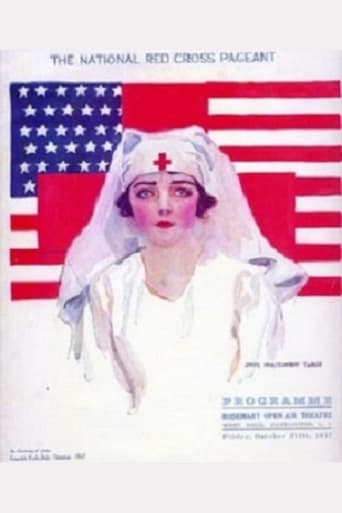
National Red Cross Pageant (1917)
The National Red Cross Pageant (1917) was an American war pageant that was performed in order to sell war bonds, support the National Red Cross, and promote a positive opinion about American involvement in World War I.
- Date of release
- 1917-12-01
- TMDB
- 8.0 / 10 (1)
- Runtime
- 50m
- Genres
- Drama
- Director
- Christy Cabanne
Casting
- Edith Wynne Matthison — Prologue
- Douglas Wood — Herald - Flemish episode
- Ethel Barrymore — Flanders / Belgium - Flemish & Final episodes
- Kitty Gordon — Bruges - Flemish episode
- Margaret Moreland — Ghent - Flemish episode
- Adelaide Prince — Ypres - Flemish episode
- Olive Tell — Louvain - Flemish episode
- Irene Fenwick — Herald - Italian episode
- Montgomery Irving — The Alps - Italian episode (as Dr. Montgomery Irving)
- Annette Kellerman — The Mediterranean - Italian episode
- Josephine Drake — The Adriatic - Italian episode
- Ethel McDonough — Leader of the Lakes - Italian episode
Interesting facts
The National Red Cross Pageant of 1917 was an American war pageant that was performed in order to sell war bonds, support the National Red Cross, and promote a positive opinion about American involvement in World War I. The live open-air pageant was presented on October 5, 1917, at the Rosemary Open Air Amphitheater on a private estate, Rosemary Farm, near Huntington, New York. The production was also captured by director Christy Cabanne as an all-star revue silent film, now considered a lost film.
Production background
On October 5, 1917, a live open-air pageant was held at the Rosemary Open Air Amphitheater on a private estate, Rosemary Farm, near Huntington, New York. It was also performed again a few weeks later at the Metropolitan Opera in New York City. Both performances drew large crowds whose numbers were in the hundreds, and consisted mostly of wealthy New Yorkers. The event was mainly the brainchild of Ben Ali Haggin, famous as a stage designer.
Presumably the filming of the pageant was made with a patriotic fervor in the wake of the United States entry into World War I in April 1917. The proceeds from the film going to the war effort, such as the Red Cross, War Bonds, etc.
A litany of famous Broadway and motion picture stars of the period participated in the production. Lionel, Ethel, and John Barrymore all appeared in the production but not together in the same scenes as they did in Rasputin and the Empress (1932). According to the National Red Cross Bulletin, 500 people appeared in the production and more than 5,000 spectators were in attendance.
The proceeds from the pageant were reported as having been in the amount of $50,000 which created a way for American citizens to make a difference for their country's participation in the Great War, and it also allowed these same citizens to feel a sense of national pride for their beloved homeland.
Its success was so remarkable, the National Red Cross later proclaimed December 7 National Red Cross Theatrical Day.
Read on Wikipedia · Text from Wikipedia, CC BY-SA 4.0. Data from Wikidata.
Recommended
- Battleground 1949 · ★ 6.7
- Prizefighter: The Life of Jem Belcher 2022 · ★ 6.2
- Come Sunday 2018 · ★ 5.8
- Gracie 2007 · ★ 6.2
- 90 Minutes in Heaven 2015 · ★ 5.9
- Walking with the Enemy 2014 · ★ 6.3
- The Visit 1964 · ★ 7.2
- Field of Lost Shoes 2015 · ★ 6.1
- Resurrecting the Champ 2007 · ★ 6.3
- Beneath Hill 60 2010 · ★ 6.8
- Hungry Hearts 2015 · ★ 6.5
- Most 2003 · ★ 7.3