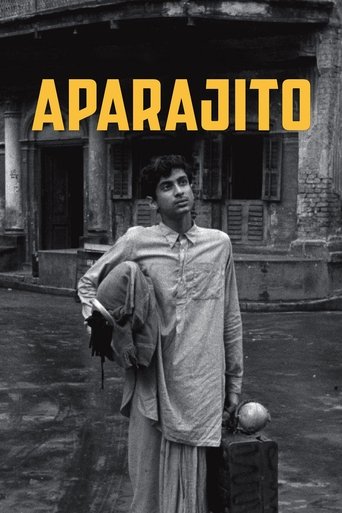
Aparajito (1956)
অপরাজিত
Apu and his family have moved away from the country to live in the bustling holy city of Benares. As he progresses from wide-eyed child to intellectually curious teenager, eventually studying in Kolkata, we witness his academic and moral education, as well as the growing complexity of his relationship with his mother.
- Date of release
- 1956-10-11
- TMDB
- 7.8 / 10 (309)
- Runtime
- 1h 50m
- Genres
- Drama
- Director
- Satyajit Ray
- Collection
- Apu Collection
Casting
- Pinaki Sengupta — Young Apurba 'Apu' Roy
- Smaran Ghosal — Teenage Apurba 'Apu' Roy
- Kanu Bannerjee — Harihar Roy
- Karuna Banerjee — Sarbajaya Roy
- Ramani Ranjan Sengupta — Bhabataran
- Charuprakash Ghosh — Nanda Babu
- Subodh Ganguly — Headmaster
- Santi Gupta — Ginnima
- Ranibala — Teliginni
- Sudipta Roy — Nirupama
- Keya Sengupta
- Kamala Adhikari — Mokshada
Interesting facts
- Awards: 1 · Nominations: 0. Including: Golden Lion
Aparajito is a 1956 Indian Bengali-language drama film written and directed by Satyajit Ray, and is the second part of The Apu Trilogy. It is an adaptation of the last part of Bibhutibhushan Bannerjee's novel Pather Panchali and the first part of his followup novel Aparajito. The film starts off where the previous film Pather Panchali (1955) ended, with Apu's family moving to Varanasi, and chronicles Apu's life from childhood to adolescence in college.
Production
Aparajito was based on the last fifth of the novel Pather Panchali and the first third of the novel Aparajito by Banerjee. The novel Pather Panchali is a classic bildungsroman (a type of coming-of-age story) in the canon of Bengali literature. It first appeared as a serial in a Calcutta periodical in 1928 and was published as a book the next year.
The novel had a female character named Leela who influenced Apu's alienation from his mother when he was living in Calcutta. After rejecting two aspirants, Ray found one actress to portray the character, but the actress was not allowed to act in the film by her fiancé. Eventually, Ray reluctantly removed the character from the script.
Subrata Mitra, the cinematographer of The Apu Trilogy, made his first technical innovation with this film: the application of bounce lighting on large scale diffusers to match studio sets with location shooting. According to the Internet Encyclopedia of Cinematographers:
The fear of monsoon rain had forced the art director, Bansi Chandragupta, to abandon the original plan to build the inner courtyard of a typical Benares house in the open and the set was built inside a studio in Calcutta. Mitra recalls arguing in vain with both Chandragupta and Ray about the impossibilities of simulating shadowless diffused skylight. But this led him to innovate what became subsequently his most important tool—bounce lighting.
Read on Wikipedia · Text from Wikipedia, CC BY-SA 4.0. Data from Wikidata.
Recommended
- Lion 2016 · ★ 8.0
- Dad 1989 · ★ 6.4
- Finding Neverland 2004 · ★ 7.3
- Bambi II 2006 · ★ 6.5
- Father Mother Sister Brother 2025 · ★ 6.4
- Pather Panchali 1955 · ★ 7.8
- The Shack 2017 · ★ 7.5
- The World of Apu 1959 · ★ 8.1
- Here 2024 · ★ 6.5
- The Hours 2002 · ★ 7.2
- The Lovely Bones 2009 · ★ 7.1
- The Salt Path 2025 · ★ 6.6