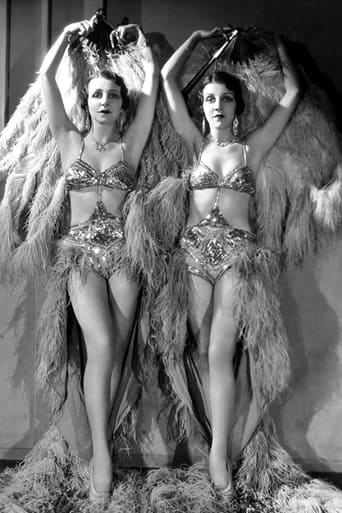
The March of Time (1930)
Unfinished pre-Code era film consisting of three sections with past performers from the stage and the vaudeville circuit, then-present-day performers and up-and-coming performers. Musical excerpts were later used in Broadway to Hollywood (1933), Nertsery Rhymes (1933), and Roast-Beef and Movies (1934). "The Lock Step" was later used in That's Entertainment! III (1994)
- Date of release
- 1930-09-01
- TMDB
- 7.0 / 10 (1)
- Runtime
- 1h 28m
- Genres
- Music
- Director
- Charles Reisner
Casting
- Bing Crosby — Self
- Marie Dressler — Self - Old Timer Sequence
- Jimmy Durante — Self
- Trixie Friganza — Self - Old Timer Sequence
- Ann Sothern — Chorus Girl (uncredited)
- Ann Dvorak — Chorus Girl (uncredited)
- Beth Dodge — Self - Lock Step Number
- Betty Dodge — Self - Lock Step Number
Interesting facts
The March of Time is the title of an unreleased 1930 American pre-Code musical film directed by Charles Reisner. The film was originally scheduled to be released in September 1930 by Metro-Goldwyn-Mayer (MGM) but was shelved. The March of Time would have been one of the many musicals partially filmed in two-color Technicolor.
Production
The unfinished film was originally titled Hollywood Revue of 1930 and was conceived by producer Harry Rapf as a follow-up to MGM's The Hollywood Revue of 1929, which he had also produced. The film was retitled The March of Time, as it was to consist of three sections which featured past performers from the stage and the vaudeville circuit, then-present-day performers and up-and-coming performers.
Among the performers who filmed scenes for The March of Time were Joe Weber and Lew Fields of the Weber and Fields comedy team, Gus Edwards, Fay Templeton, Marie Dressler, Van and Schenck, DeWolf Hopper Sr., Buster Keaton, Albertina Rasch and her dancers, Polly Moran, Cliff Edwards, Benny Rubin, Ramon Novarro performing "Long Ago in Alcala," Bing Crosby performing "Poor Little G-String,"the Duncan Sisters performing "Graduation Day," Barney Fagan…
In order to salvage the $750,000 ($14.5 million in 2025) that had already been spent on the film, MGM announced plans to use the footage in a planned project starring Jimmy Durante that was to be released in 1932. That project was also abandoned. Footage from The March of Time later found its way into the musical shorts The Devil's Cabaret (1930), Crazy House (1930), Nertsery Rhymes (1933), Hello Pop! (1933) and Jail Birds of Paradise (1934).
Read on Wikipedia · Text from Wikipedia, CC BY-SA 4.0. Data from Wikidata.
Recommended
- The Wrecking Crew 2008 · ★ 7.4
- The Big Store 1941 · ★ 6.3
- Ghosts 1997 · ★ 8.1
- I Called Him Morgan 2016 · ★ 7.0
- Let It Shine 2012 · ★ 7.0
- Make Mine Music 1946 · ★ 5.8
- End of the Century: The Story of the Ramones 2003 · ★ 7.6
- Lemmy 2010 · ★ 7.6
- Black Is King 2020 · ★ 7.1
- Animal Crackers 1930 · ★ 6.9
- Love Happy 1949 · ★ 5.8
- Footlight Parade 1933 · ★ 6.8