모아나 (1926)
Moana
에스키모의 삶을 촬영한 다큐멘터리
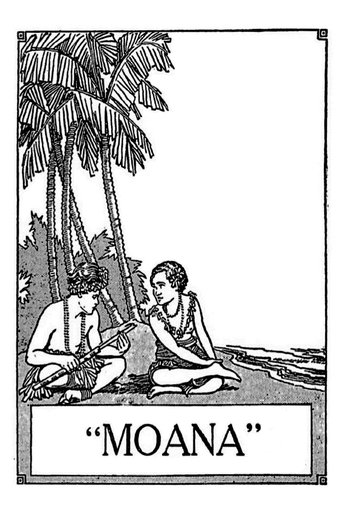
(1922)의 성공에 힘입어 플래허티는 파라마운트로부터 폴리네시아에 관한 다큐멘터리를 제작할 것을 제안받게 된다. 아내와 함께 사모아 섬에 도착한 플래허티는 백인들이 이 섬에 도착하기 이전의 원주민들의 삶의 방식을 자신의 카메라에 담고자 하였다. 는 낚시, 요리, 축제 등 현대문명에 노출되지 않은 폴리네시아 원주민들의 일상이 담긴 영화로, 플래허티는 인위적인 연출을 통해 작품에 극적 긴장감을 불어넣기보다는 객관적이고 관조적인 시선으로 원주민들의 소박하지만 아름다운 삶을 응시하고 있다. (부산시네마센터 2011 - [개관영화제]백화열전)
- 개봉일
- 1926-01-07
- TMDB
- 6.7 / 10 (38)
- 상영 시간(분)
- 1시간 38분
- 장르
- 다큐멘터리
- 감독
- Robert Flaherty, Frances H. Flaherty
출연진
- Ta'avale — Moana
- Fa'amgase — Moana's Fiancé
- Tama — Moana's Father
- T'ugaita — Moana's Mother
- Pe'a — Moana's Younger Brother
- Leupenga — Moana's Older Brother
흥미로운 사실
Moana is a 1926 American silent documentary film, or more strictly a work of docufiction, which was directed by Robert J. Flaherty, creator of Nanook of the North (1922), and his wife Frances H. Flaherty. A reviewer of the film coined the now-common term "documentary".
Production
Moana was filmed in Samoa (then under the Western Samoa Trust Territory) in the villages of Safune district on the island of Savai'i. The name of the lead male character, Moana, means 'deep sea, deep water' in the Samoan language. In making the film, Flaherty lived with his wife and collaborator Frances H. Flaherty and their three daughters in Samoa for more than a year.
Hoping that Flaherty could repeat the success of Nanook, Paramount Pictures sent him to Samoa to capture the traditional life of the Polynesians on film. Flaherty reportedly arrived with 16 tons of filmmaking equipment. This included both a regular movie camera and a Prizma color camera, as Flaherty hoped to film some footage in that color process, but the Prizmacolor camera malfunctioned.
Moana is thought to be the first feature film made with panchromatic black-and-white film rather than the orthochromatic film commonly used at the time in Hollywood feature films. Flaherty developed his film as he went along, in a cave on Savai'i. In the process, he inadvertently poisoned himself and required treatment after he drank water from the cave that contained silver nitrate, which washed off the film stock.
As in the earlier Nanook (and his later film, Man of Aran), Flaherty went well beyond recording the life of the people of Samoa as it happened. He followed his usual procedure of "casting" locals whom he considered potentially photogenic performers into "roles", including creating fictitious family relationships.
He also, as in the other films, on occasion set up scenes in which exotic earlier practices were re-enacted as if still current. In Nanook and Man of Aran, it included setting up anachronistic hunting sequences. In Moana, at a time when Samoans were typically wearing modern Western-style clothing under the influence of Christian missionaries, Flaherty persuaded his performers to don traditional tapa cloth costumes (made from the bark of the paper…
위키백과에서 더 읽기 · 텍스트 출처: 위키백과, CC BY-SA 4.0. 데이터 출처: Wikidata.
추천
- 바라카 1992 · ★ 8.2
- 돌고래와 산호초의 시민들 2018 · ★ 6.8
- 나코이카시 2002 · ★ 6.2
- 뉴욕 라이브러리에서 2017 · ★ 6.4
- 딥씨 챌린지 2014 · ★ 6.6
- 웨스턴 스타스 2019 · ★ 7.0
- 포와카시 1988 · ★ 7.2
- 코야니스카시 1983 · ★ 7.9
- 180도 사우스 2010 · ★ 7.2
- 오아시스: 돈 룩 백 인 앵거 2026 · ★ 6.9
- '찰리 브라운, 너는 누구니?' - Who Are You, Charlie Brown? 2021 · ★ 6.9
- 엘스트리 1976 2015 · ★ 6.2