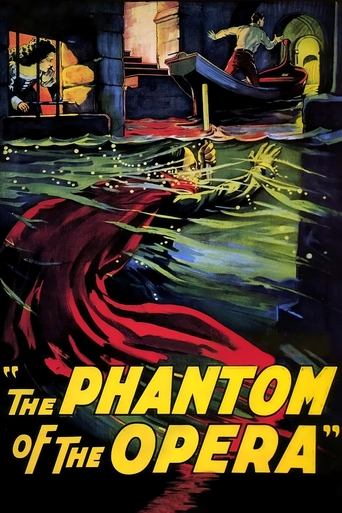
The Phantom of the Opera (1925)
The greatest horror film of modern cinema!
The deformed Phantom who haunts the Paris Opera House causes murder and mayhem in an attempt to make the woman he loves a star.
- Date of release
- 1925-06-29
- TMDB
- 7.1 / 10 (429)
- Runtime
- 1h 47m
- Genres
- Horror, Music
- Director
- Rupert Julian
Casting
- Lon Chaney — Erik, The Phantom
- Norman Kerry — Vicomte Raoul de Chagny
- Mary Philbin — Christine Daaé
- Arthur Edmund Carewe — Ledoux
- Gibson Gowland — Simon Buquet
- Snitz Edwards — Florine Papillon
- John St. Polis — Comte Philip de Chagny
- Virginia Pearson — Carlotta
- Olive Ann Alcorn — La Sorelli (uncredited)
- Betty Van Allen — Ballerina (uncredited)
- Betty Arthur — Ballet Dancer (uncredited)
- Joseph Belmont — Stage Manager (uncredited)
Interesting facts
- Budget: $632.4K
- Based on: The Phantom of the Opera
The Phantom of the Opera is a 1925 American silent gothic horror film adaptation of Gaston Leroux's 1910 novel of the same name directed by Rupert Julian and starring Lon Chaney in the title role of the deformed Phantom who haunts the Paris Opera House, causing murder and mayhem in an attempt to make the woman he loves a star. The film remains most famous for Chaney's ghastly, self-devised make-up, which was kept a studio secret until the film's premiere. The picture also features Mary Philbin, Norman Kerry, Arthur Edmund Carewe, Gibson Gowland, John St. Polis and Snitz Edwards.
Production
Production began in mid-October but encountered many problems. According to director of photography Charles Van Enger, Chaney and the rest of the cast and crew had strained relations with director Rupert Julian. Chaney and Julian eventually stopped communicating, so Van Enger served as a go-between. He would report Julian's directions to Chaney, who responded "Tell him to go to hell." As Van Enger remembered, "Lon did whatever he wanted."
Julian had become Universal's prestige director by completing the Merry-Go-Round (1923) close to budget after original director Eric von Stroheim had been fired. But on the set of The Phantom of the Opera, his lack of skill as a director was obvious to the crew.
The ending changed yet again during filming. The scripted chase scene through Paris was discarded in favor of an unscripted and more intimate finale. To save Raoul, Christine agrees to wed Erik and kisses his forehead. Erik is overcome by Christine's purity and his own ugliness. The mob enters his lair under the Opera House, only to find the Phantom slumped dead over his organ, where he had been playing his composition Don Juan Triumphant.
By mid-November 1924, the majority of Chaney's scenes had been filmed. Principal photography was completed just before the end of the year, with 350,000 feet of negative exposed. Editor Gilmore Walker assembled a rough cut of nearly four hours, but the studio demanded a length of no more than 12 reels.
A score was prepared by Joseph Carl Breil. No information about the score survives other than Universal's release: "Presented with augmented concert orchestra, playing the score composed by Briel, composer of music for The Birth of a Nation". The opening-day full-page advertisement in the Call-Bulletin read: "Universal Weekly claimed a 60-piece orchestra.
Read on Wikipedia · Text from Wikipedia, CC BY-SA 4.0. Data from Wikidata.
Recommended
- The Phantom of the Opera 1962 · ★ 6.4
- Peeping Tom 1960 · ★ 7.4
- Mostly Ghostly 3: One Night in Doom House 2016 · ★ 6.2
- The Adventures of Ichabod and Mr. Toad 1949 · ★ 6.5
- Carnival of Souls 1962 · ★ 7.0
- Alice's Adventures in Wonderland 1972 · ★ 6.2
- Snow White: A Tale of Terror 1997 · ★ 6.1
- Van Helsing 2004 · ★ 6.4
- The Haunting Hour: Don't Think About It 2007 · ★ 6.9
- The Innocents 1961 · ★ 7.5
- Annie: A Royal Adventure 1995 · ★ 6.1
- Monkey’s Magic Merry Go Round 2026 · ★ 7.5