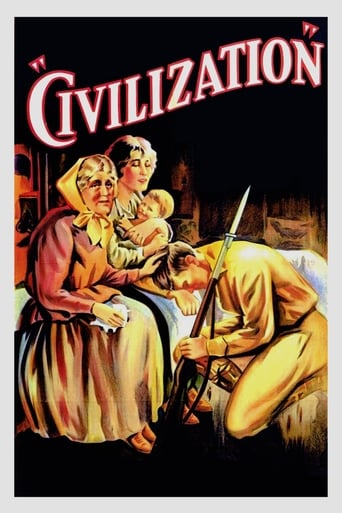
Civilization (1916)
An epic of humanity
Count Ferdinand, a submarine commander and secret pacifist refuses to torpedo a defenseless passenger ship during wartime. His submarine is sunk in the following fracas. In the spirit world, Christ commends the captain, and returns to earth in the commander's body to promote His message of peace.
- Date of release
- 1916-06-02
- TMDB
- 5.2 / 10 (14)
- Runtime
- 1h 26m
- Genres
- Drama
- Director
- Thomas H. Ince, Reginald Barker, Raymond B. West
Casting
- Kate Bruce — A Mother
- J. Frank Burke — Luther Rolf - The Peace Advocate
- Claire Du Brey
- George Fisher — The Christ
- Charles K. French — The Prime Minister
- Thomas H. Ince — Himself - in Prologue
- Herschel Mayall — The King of Wredpryd
- Lola May — Queen Engenie
- Howard Hickman — Count Ferdinand
- Enid Markey — Katheryn Haldemann
- John Gilbert — Extra (uncredited)
- Alice Terry — Extra (uncredited)
Interesting facts
Civilization is a 1916 American pacifist drama film produced by Thomas H. Ince, written by C. Gardner Sullivan and Edward Sloman, and directed by Ince, Reginald Barker and Raymond B. West. The story involves a submarine commander who refuses to fire at a civilian ocean liner supposedly carrying ammunition for his country's enemies. The film was a big-budget spectacle that was compared to both The Birth of a Nation and the paintings of Jean-François Millet. The film was a popular success and was credited by the Democratic National Committee with helping to re-elect Woodrow Wilson as the U.S. president in 1916.
Production
Civilization was a big budget spectacle from Thomas H. Ince. It was in production for nearly a year and advertised to have cost $1,000,000 to make but actually cost only $100,000 and returned $800,000.
C. Gardner Sullivan, The film's screenwriter, said he received the inspiration for the film on Easter Sunday morning in 1915. He wrote an outline on a single piece of typewriter paper, originally calling it "The Mothers of Men." Sullivan showed the outline to Ince, and Ince decided it was worth investing $1 million.
In April 1916, the Los Angeles Times wrote:
The next large feature looming on the horizon is the Ince photoplay, Civilization...It was nearly a year in the making, and is the most pretentious of the Ince features. Many hundreds of persons took part, and it is said that the film contains some of the most beautiful photography ever shown on the screen.
At the time of its release, it was described as "the ultimate achievement of the Ince studios."
Read on Wikipedia · Text from Wikipedia, CC BY-SA 4.0. Data from Wikidata.
Recommended
- The Black Pirate 1926 · ★ 6.7
- Hurry Sundown 1967 · ★ 6.4
- Brand Upon the Brain! 2007 · ★ 6.6
- Fast Girls 2012 · ★ 6.0
- The River 1984 · ★ 6.4
- Operation Pacific 1951 · ★ 6.1
- Eleanor the Great 2025 · ★ 6.8
- Blue Chips 1994 · ★ 6.1
- Return 2011 · ★ 6.4
- Battleground 1949 · ★ 6.7
- Fatima 2020 · ★ 7.2
- Waiting for Anya 2020 · ★ 6.3