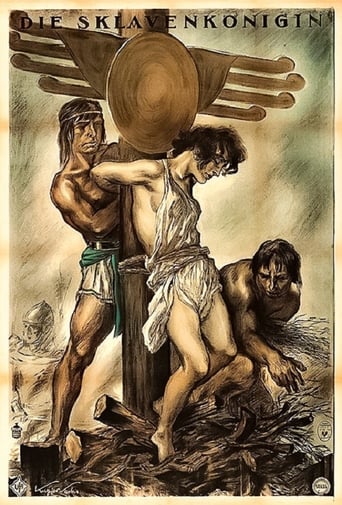
Moon of Israel (1924)
Die Sklavenkönigin
Daring Romance! Swift Action! Breath-Taking Thrills! A Succession of Stupendous Spectacles!
A Jewish slave girl falls in love with the Pharaoh's son during the Exodus.
- Date of release
- 1924-10-25
- TMDB
- 6.8 / 10 (6)
- Runtime
- 2h 24m
- Genres
- Drama
- Director
- Michael Curtiz
Casting
- María Corda — Merapi, The Moon of Israel
- Adelqui Migliar — Prince Seti
- Arlette Marchal — Userti
- Ferdinand Onno — Poet Ana
- Oscar Beregi Sr. — Amenmeses
- Henry Mar — Moses
- Adolf Weisse — Pharaoh Menapta
- Reinhold Häussermann — Pampasa
- Georges Haryton — Laban
- Emil Heyse — Khi, the High Priest
- Boris Baronoff — Nathan, Merapi's father
- Hans Thimig
Interesting facts
- Based on: Moon of Israel
The Moon of Israel is a 1924 Austrian epic film. It was directed by Mihaly Kertész. The script was written by Ladislaus Vajda, based on H. Rider Haggard's 1918 novel Moon of Israel, which in its turn was inspired by the Biblical story of the Exodus.
Production
One of the most outstanding scenes is the parting of the Red Sea by Moses (Hans Marr). Since at the same time the American film The Ten Commandments was being made, which also featured the parting of the Red Sea, the Viennese team took extraordinary care over this scene out of fear of superior American special effects technology.
The actors were filmed in the dry and overwhelmed by the "sea" later, during the editing. When, a few weeks after the Sklavenkönigin opened, the competing film was also in the cinemas, it came as a surprise that the parting of the Red Sea was considerably more realistic in the Austrian production.
The director of Sascha-Film, Arnold Pressburger, assisted the film director Michael Kertész as artistic director. The assistant director was Arthur Gottlein. The cameramen Max Nekut, Gustav Ucicky and Hans Theyer were supported by Sascha Kolowrat-Krakowsky, the film's producer, as technical director.
The film is supposed to have cost 1.5 billion Kronen. The true value of the sum is admittedly relativised by the constant high inflation that raged until the mid-1920s. Still, nevertheless it is one of the highest outlays ever for an Austrian film. Sascha-Film was only able to obtain credit from their bank against the personal security provided by Sascha Kolowrat-Krakowsky.
Read on Wikipedia · Text from Wikipedia, CC BY-SA 4.0. Data from Wikidata.
Recommended
- The Ten Commandments 1956 · ★ 7.8
- The Prince of Egypt 1998 · ★ 7.3
- Joseph: King of Dreams 2000 · ★ 6.9
- Jacob 1994 · ★ 6.7
- Abraham 1993 · ★ 7.2
- Until the End of the World 1991 · ★ 6.7
- The Black Pirate 1926 · ★ 6.7
- Holy Lands 2019 · ★ 6.1
- Land of the Pharaohs 1955 · ★ 6.5
- The Egyptian 1954 · ★ 6.5
- Sky 2016 · ★ 6.2
- Skin 2009 · ★ 6.4