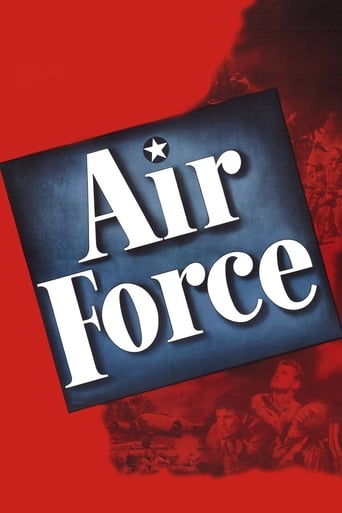
Air Force (1943)
GIANTS OF THE SKY...blazing a trail to victory!
The crew of an Air Force bomber arrives in Pearl Harbor in the aftermath of the Japanese attack and is sent on to Manila to help with the defense of the Philippines.
- Date of release
- 1943-03-20
- TMDB
- 6.5 / 10 (66)
- Runtime
- 2h 4m
- Genres
- Action, Drama, War, Adventure
- Director
- Howard Hawks
Casting
- John Ridgely — Pilot
- Gig Young — Co-Pilot
- John Garfield — Tail Gunner Joe Winocki
- Arthur Kennedy — Bombardier
- George Tobias — Asst. Crew Chief
- Charles Drake — Navigator
- Harry Carey — Crew Chief
- Ward Wood — Radio Operator Peterson
- Ray Montgomery — Asst. Radio Operator Chester
- James Brown — Pilot Tex Rader
- Stanley Ridges — Maj. Mallory - Clark Field
- Willard Robertson — Colonel at Hickam Field
Interesting facts
- Filmed in: Randolph Air Force Base and 1 more
- Awards: 2 · Nominations: 4. Including: Academy Award for Best Film Editing; National Board of Review: Top Ten Films
Air Force is a 1943 American World War II aviation film directed by Howard Hawks and starring John Garfield, John Ridgely, Gig Young, Arthur Kennedy, and Harry Carey. The film was distributed by Warner Bros. Pictures and produced by Hal B. Wallis and Jack L. Warner. It contains incidents of supposed fifth-column activities by Japanese Americans that never happened. Conceived by then-Lieutenant General “Hap” Arnold in the aftermath of the Pearl Harbor attack, it was originally scheduled for release on December 7, 1942, on the first anniversary. It became impossible to meet that deadline, and it premiered in New York City on February 3, 1943, and was released on March 20.
Production
Director Howard Hawks credited the concept of the film to Lieutenant General Henry H. Arnold, Commanding General of the Army Air Forces, loosely based on the experiences of an actual flight of twelve B-17s that left Hamilton Field, California, on the night of December 6, 1941, and literally flew into the war the next morning at Pearl Harbor.
Although pre-production work had already been done, the official start of the production on 18 May 1942 was tied to the War Department's approving the script. Development of the film was concurrent with scriptwriting by Dudley Nichols, with some characters based on Air Corps personnel Hawks met while traveling to Washington, D.C., to confer with Arnold and the War Department Motion Picture Board of Review.
Principal photography, consisting of aerial shots and exteriors, took place at Hendricks Army Airfield, Florida. For water scenes and shooting miniatures shots, MacDill Field, Florida; Randolph Field, Texas; and Santa Monica Bay, California, were used. Shooting began 18 June 1942, using a rented mock-up of a B-17 interior, in which the 10 principal characters performed for a month.
At the end of August, Hawks returned to Hollywood and engaged William Faulkner to rewrite two scenes, including the death of the Mary-Ann's pilot. By then, the film, scheduled to be completed by 17 September, was three weeks behind schedule and only half completed. Production featured a celebrated clash between producer Hal Wallis and Hawks over the latter's constant changing of dialogue as scenes were shot.
Wallis wrote that AAF Captains Sam P. Triffy and Hewett T. Wheless were technical advisors to the film, and that Triffy in particular made significant contributions to the storyline, dialogue, and sets. "Shorty" Wheless had previously been a B-17 aircraft commander in the Philippines with the 19th Bomb Group and had been one of the survivors evacuated to Australia in December 1941.
Read on Wikipedia · Text from Wikipedia, CC BY-SA 4.0. Data from Wikidata.
Recommended
- The Final Countdown 1980 · ★ 6.6
- Operation Pacific 1951 · ★ 6.1
- Thirty Seconds Over Tokyo 1944 · ★ 6.7
- They Were Expendable 1945 · ★ 6.5
- Attack Force Z 1982 · ★ 5.9
- Flying Tigers 1942 · ★ 6.3
- The Fighting Seabees 1944 · ★ 6.2
- Strategic Air Command 1955 · ★ 6.1
- Battleground 1949 · ★ 6.7
- The Bridges at Toko-Ri 1954 · ★ 6.0
- The Guns of Navarone 1961 · ★ 7.3
- The Last Rifleman 2023 · ★ 6.6