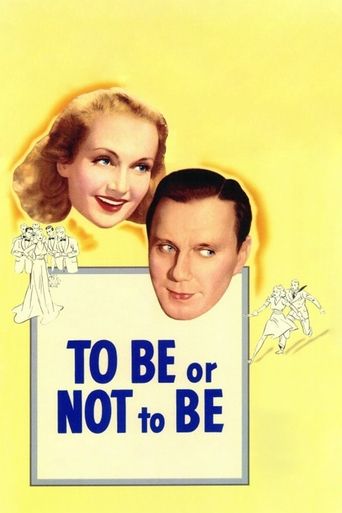
To Be or Not to Be (1942)
The Picture Everyone Wants to See
During the Nazi occupation of Poland, an acting troupe becomes embroiled in a Polish soldier's efforts to track down a German spy.
- Date of release
- 1942-03-06
- TMDB
- 7.8 / 10 (889)
- Runtime
- 1h 39m
- Genres
- Comedy, War, Romance
- Director
- Ernst Lubitsch
Casting
- Carole Lombard — Maria Tura
- Jack Benny — Joseph Tura
- Robert Stack — Lieut. Stanislav Sobinski
- Felix Bressart — Greenberg
- Lionel Atwill — Rawitch
- Stanley Ridges — Professor Alexander Siletsky
- Sig Ruman — Col. Ehrhardt
- Tom Dugan — Bronski
- Charles Halton — Producer Dobosh
- George Lynn — Actor-Adjutant
- Henry Victor — Capt. Schultz
- Maude Eburne — Anna
Interesting facts
- Budget: $1.2M
- Awards: 0 · Nominations: 1
To Be or Not to Be is a 1942 American black comedy film produced and directed by Ernst Lubitsch, starring Carole Lombard and Jack Benny, and featuring Robert Stack, Felix Bressart, Lionel Atwill, Stanley Ridges, and Sig Ruman. The plot concerns a troupe of actors in Nazi-occupied Warsaw who use their abilities at disguise and acting to fool the occupying troops. It was adapted by Lubitsch (uncredited) and Edwin Justus Mayer from the story by Melchior Lengyel. To Be or Not to Be was released one month after Lombard was killed in an airplane crash.
Production
Lubitsch had never considered anyone other than Jack Benny for the lead role in the film. He had even written the character with Benny in mind. Benny, thrilled that a director of Lubitsch's caliber had been thinking of him while writing it, accepted the role immediately. Benny was in a predicament as, strangely enough, his success in the film version of Charley's Aunt (1941) did not interest anyone in hiring the actor for their films.
For Benny's co-star, the studio and Lubitsch decided on Miriam Hopkins, whose career had been faltering in recent years. The role was designed as a comeback for the veteran actress, but Hopkins and Benny did not get along well, and Hopkins left the production.
Lubitsch was left without a leading lady until Carole Lombard, hearing his predicament, asked to be considered. Lombard had never worked with the director and yearned to have an opportunity. Lubitsch agreed and Lombard was cast. The film also provided Lombard with an opportunity to work with friend Robert Stack, whom she had known since he was a teenager.
Read on Wikipedia · Text from Wikipedia, CC BY-SA 4.0. Data from Wikidata.
Recommended
- To Be or Not to Be 1983 · ★ 6.7
- Oh! What a Lovely War 1969 · ★ 6.7
- Operation Petticoat 1959 · ★ 7.2
- The Grass Is Greener 1960 · ★ 6.4
- What Did You Do in the War, Daddy? 1966 · ★ 5.9
- Carry On Sergeant 1958 · ★ 6.4
- This Means War 2012 · ★ 6.2
- A Good Woman 2004 · ★ 6.3
- Keeping the Faith 2000 · ★ 6.1
- She's Funny That Way 2015 · ★ 5.9
- How to Marry a Millionaire 1953 · ★ 6.8
- Block-Heads 1938 · ★ 7.0