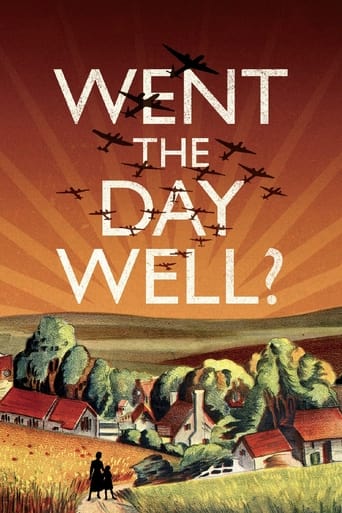
Went the Day Well? (1942)
Went the day well? We died and never knew. But, well or ill, freedom we died for you.
The quiet village of Bramley End is taken over by German troops posing as Royal Engineers. Their task is to disrupt England's radar network in preparation for a full scale German invasion. Once the villagers discover the true identity of the troops, they do whatever they can to thwart the Nazis plans.
- Date of release
- 1942-12-07
- TMDB
- 7.1 / 10 (80)
- Runtime
- 1h 32m
- Genres
- War, Thriller
- Director
- Alberto Cavalcanti
Casting
- Leslie Banks — Oliver Wilsford
- Elizabeth Allan — Peggy
- Frank Lawton — Tom Sturry
- Basil Sydney — Major Hammond / Kommandant Orlter
- Valerie Taylor — Nora Ashton
- Mervyn Johns — Charlie Sims
- Edward Rigby — Bill Purvis
- Marie Lohr — Mrs. Dolly Fraser
- C. V. France — The Vicar Ashton
- David Farrar — Lieutenant Jung
- Muriel George — Mrs. Collins
- Thora Hird — Ivy
Interesting facts
Went the Day Well? is a 1942 British war film adapted from a story by Graham Greene and directed by Alberto Cavalcanti. It was produced by Michael Balcon of Ealing Studios and served as unofficial propaganda for the war effort. The film shows a village in southern England taken over by German paratroopers, reflecting the greatest fear of the British public of the time, although the threat of German invasion had largely receded. The film is notable for its unusually, for the time, frank depiction of ruthless violence.
Production
The film was based on a short story by the author Graham Greene entitled "The Lieutenant Died Last". The film's title is based on an epitaph written by the classical scholar John Maxwell Edmonds. It originally appeared in The Times on 6 February 1918 entitled "Four Epitaphs".
"Went the day well" also appears in an unidentified newspaper cutting in a scrapbook now held in the RAF Museum (AC97/127/50), and in a collection of First World War poems collated by Vivien Noakes.
This was the first significant role of Thora Hird's career, and one of the last for C. V. France.
Exterior scenes were shot on location in the village of Turville in Buckinghamshire.
Read on Wikipedia · Text from Wikipedia, CC BY-SA 4.0. Data from Wikidata.
Recommended
- The Four Feathers 1939 · ★ 7.1
- The Young Lions 1958 · ★ 6.7
- Hell Is for Heroes 1962 · ★ 6.5
- The Guns of Navarone 1961 · ★ 7.3
- All Quiet on the Western Front 1979 · ★ 6.7
- 49th Parallel 1941 · ★ 7.0
- All Quiet on the Western Front 1930 · ★ 7.8
- Paths of Glory 1957 · ★ 8.3
- Tobruk 1967 · ★ 6.4
- Battleground 1949 · ★ 6.7
- When the Wind Blows 1986 · ★ 7.5
- The Man Who Never Was 1956 · ★ 7.0